He is risen !
N° 273 – January 2026
Director : Frère Bruno Bonnet-Eymard
To Console Our Lady!
WE are still enthralled by the wonderful memories of our pilgrimage to Lourdes and Garaison last October, a pilgrimage of reparation to the Immaculate Heart of Mary. We wanted to make reparation and console our dear Heavenly Mother in this centenary year of Her apparition in Pontevedra on December 10, 1925.
We went to the feet of the Immaculate Conception, the “Beautiful Lady” of Massabielle, “Aquero,” after being denied access to the Holy Mountain of the Weeping Virgin of La Salette, and since we could not go to Pontevedra itself, which was too far, too expensive and too small for our 1,400 pilgrims.
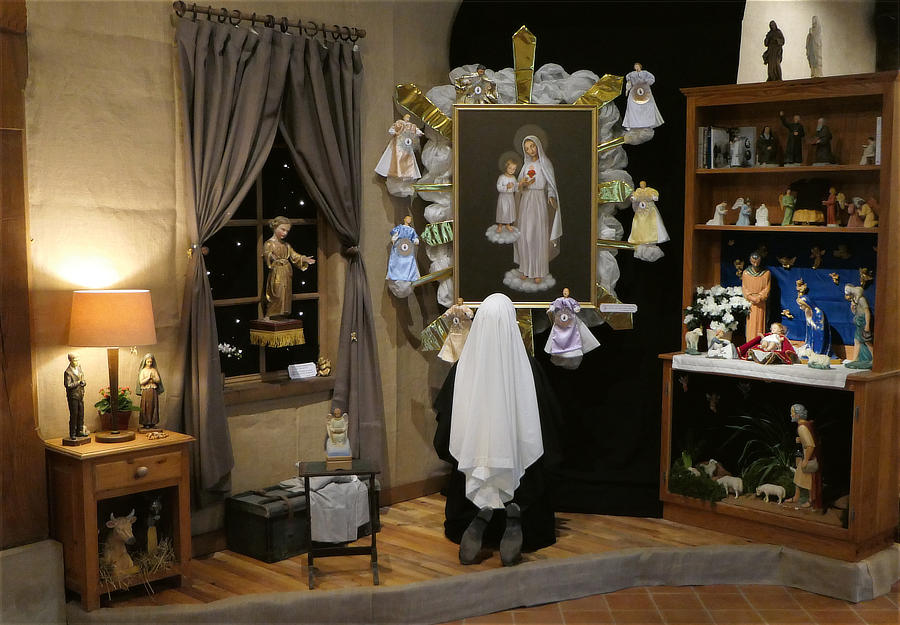
Well, our brothers did not admit defeat: since we were unable to go to Pontevedra, they brought it to our chapel! Giving this year’s crib an original and very daring character.
DECEMBER 10, 1925,
THE COMPASSION OF GOD’S HEART.
The impression is immediate: we are transported to the humble cell of Sister Maria das Dores, Lucy dos Santos, who entered the convent of Sisters of Saint Dorothy in Pontevedra. Life-size, she looks as though she were alive!
Kneeling, she contemplates the apparition she was privileged to see on the evening of December 10, 1925; a wonderful representation, painted by a Phalangist friend, allows us to share Sister Lucy’s rapture. The Immaculate Virgin stands beside the Child Jesus, Who is carried by a small divine cloud. She extends Her left hand to place it on Lucy’s shoulder, while Her other hand presents Her Immaculate Heart crowned with thorns.
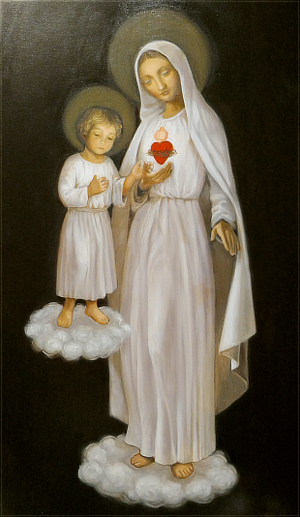 The Child Jesus, Whom the cloud raises to the height of His Mother’s Heart, has placed His right hand on His Divine Heart to contain the sorrows that oppress Him and, on the verge of tears, He says to Lucy, pointing to the Immaculate Heart of Mary:
“Have compassion on the Heart of your Most Holy Mother, covered with thorns, with which ungrateful men pierce It at every moment, without anyone making an act of reparation to remove them.”
The Divine Little Jesus reveals to us a striking mystery: At present, ungrateful men are constantly driving thorns into Her Heart. These are the sacrileges, blasphemies and sins that outrage the Person of the Blessed Virgin and pierce Her Immaculate Heart... and no act of reparation is being made to remove them.
The intention, principle and goal of this reparation and expiation, that the Child Jesus is asking for, is to console the Heart of His Mother, Whom He loves infinitely and Whose suffering He cannot bear to see without being affected Himself.
He is calling us to be victims of love for the consolation of God and the Virgin Mary.
Eight years earlier, on July 13, 1917 in Fatima, Our Lady had announced to the three little shepherds that She would come “to ask for the reparatory Communion of the first Saturdays of the month;” the two statuettes of Saints Francisco and Jacinta on the bedside table are there to remind us of this.
On the evening of December 10, 1925, the Virgin Mary honoured Her promise: “Behold, My daughter, My Heart surrounded by thorns with which ungrateful men pierce Me at every moment by their blasphemies and their ingratitude. You at least try to console Me.” What causes Her suffering are the blasphemies and ingratitude towards Her own Heart, because our beloved Heavenly Father cannot bear them and those who persist in them fall into Hell.
She then specifies what this reparatory devotion of the five First Saturdays of the month, which we practise and try to propagate, consists of: “Say that I promise to assist at the hour of death with all the graces necessary for the salvation of their souls all those who, on the first Saturday of five consecutive months, go to confession, receive Holy Communion, recite five decades of the Rosary and keep Me company for fifteen minutes whilst meditating on the fifteen mysteries of the Rosary, in a spirit of reparation.” It is therefore a matter of life or death, eternal death!
Why five? Our Lord explained to Sister Lucy on May 29, 1930 that He asked for five Saturdays because there are “five types of offences and blasphemies committed against the Immaculate Heart of Mary.” Angels are represented here surrounding the apparition, each of them holding in their hands the five privileges of the Immaculate Heart of Mary against which the ungodly blaspheme. At the top, an angel draped in gold lets shine forth the privilege, which is none other than Her very Name revealed at Lourdes: “I am the Immaculate Conception.” On either side of the painting, two angels proclaim Her perpetual Virginity and Her divine Motherhood, which makes Her not only the Mother of God, of Her Son, Jesus, but also the Mother of the men and women saved by Jesus, who are therefore our brothers and sisters. A fourth angel sings of the most lovable Mother, for Our Lord asks us to make reparation for the blasphemies of those who publicly seek to sow in the hearts of children indifference or scorn, or even hatred of this most endearing Mother. And finally, a fifth angel reminds us that we must also make reparation for the offences of those who outrage Her directly in Her holy images.
However, two angels have been added to defend the two privileges attacked today by the Congregation for the Doctrine of the Faith: the universal Mediation of graces that we receive for our salvation, all of which pass through Her Immaculate Heart, and Her Co-redemption, which merits us these graces of salvation. These two angels do not, however, presume to increase the number of Saturdays requested by Our Lady; rather they wish to make us understand that this reparatory devotion is more necessary and relevant than ever, because the souls for whom no one prays fall inexorably into Hell!
We must expiate to console the Heart of Mary. This consolation is so pleasing to the Heart of God that it merits for those who devote themselves to it the grace of eternal salvation promised by Our Lady, for themselves and for the “sinners” for whom they pray in their Ave Maria.
At Fatima, in Her insistent pleas for prayer for sinners, Our Lady revealed that this devotion is capable of earning them the graces necessary for repentance. If we console the Heart of our Mother for the ingratitude She suffers from sinners, those same sinners will be saved, and if we do not console Her, they will not be saved. What a mystery!
THE INCARNATION, OR GOD’S LOVE FOR THE IMMACULATA.
During this Christmas season, let us turn our gaze to the crib that Sister Lucy has set up in her library, to discover the unfathomable mystery of love revealed by the birth of the Son of God from the womb of an Immaculate Virgin.
At first glance, we see only a Mother with Her Son. However, if we think about Who this Son is and Who this Mother is, this unique couple is much more mysterious and bursts all the bounds of our human relationships.
This little Child with blond hair and blue eyes Who so kindly reaches out His arms to us is the Son of God, the Creator Who was before all ages, the Almighty. And She, this humble Mary kneeling in adoration, is the Daughter of God, His creature, completely submissive and obedient, and even awaiting His grace, She receives everything from Him. And yet, to our delighted eyes, it is the opposite that we contemplate at Christmas: is it not the Virgin Mary Who has just offered Her God flesh, feet to walk to meet men, and a mouth to speak to them? Does not this Son owe everything to His Mother on this blessed Christmas night? What a prodigious reversal!
It is He Who gives Her being, life, movement, and grace by coming into Her. It is He Who asks to come into Her and Who comes. He is the Head and the Man, and She is the humble servant Who lends Herself to His works, to His service. God the Creator became the Son of His Immaculate Conception, tenderly loved and cherished, out of love for Her and, through Her, in Her, the Father of all their children.
This dwelling of Him in Her is the holy and entirely virginal replica of the marriage of a bridegroom and his bride, in an exchange of love that is divinely more perfect, deeper and more intimate, where it is impossible to know which of the two gives the most and which receives the most.
Only God could manifest such love to the point of becoming the Son, submissive and dependent on His Beloved! And it was in this humble and loving condition that Our Lord appeared in Pontevedra.
He thus reveals that it is His good pleasure to grant salvation to those who strive to practise the virtues of His childhood: humility, simplicity, love of the Blessed Virgin and obedience to the will of God. These are the divine remedies for pride, which is the root of all evil since original sin and which reigns supreme in our ungodly society. Catastrophes, trials and wars are punishments that God allows in order to humble our pride. Yet the conceited world only becomes more hardened!
A hundred years ago, the Child Jesus came to reveal His compassion for His Mother. She is suffering, Her Heart is surrounded by thorns, and we do not care!
THANKSGIVING FOR A HOLY YEAR.
The shelves of the bookcase, which serves as a stable for the crib, form a modest ex-voto, in thanksgiving for our pilgrimages during this jubilee year.
The statues of the Sacred Heart and Our Lady of Lourdes, which are placed on the top of the bookcase, evoke our two pilgrimages at the beginning and end of the year.
Just one year ago, all of our communities in France gathered in Paray-le-Monial to visit the places where the Sacred Heart had revealed Himself to Saint Margaret Mary three hundred and fifty years earlier, marking the beginning of the end times. Finally, in October, the whole Phalange in array was at the feet of the Immaculate Conception in the cleft of Her rock, in Lourdes. A small white Pietà recalls the wonderful and consoling visit to the sanctuary of Our Lady of Garaison, a sanctuary of the Counter-Reformation, which concluded our pilgrimage of reparation.
Our Lady asks us to keep Her company “fifteen minutes while meditating on the fifteen mysteries of the Rosary in a spirit of reparation.” Sister Lucy was well aware that this is often the greatest difficulty. She wrote to her mother, Maria Rosa, on July 24, 1927: “The fifteen minutes of meditation might, I think, give you some trouble, but it is quite easy. Who would have difficulty thinking about the mysteries of the Rosary? To think about the Annunciation of the Angel to Mary and the humility of our dear Mother, Who seeing Herself so exalted, calls Herself the Handmaid of the Lord; about the Passion of Jesus, Who suffered so much for our love; and about our Most Holy Mother near to Jesus on Calvary? Who could not spend fifteen minutes in these holy thoughts, before the tenderest of mothers?
Another example? In our nativity scene, two angels present the Holy Tunic as we had the grace to venerate it on May 1 last, in the Basilica of Saint-Denys in Argenteuil. This relic is a poignant meditation on the sorrowful mysteries in which Our Lady has Her eminent place as Co-Redemptrix: this seamless Tunic woven by the Immaculate Virgin covered the holy Body of Jesus in the tragic hours of His Passion. It is impregnate with His Precious Blood and sweat from His Agony, Flagellation, and the carrying of the Cross. The Roman soldiers who did not want to tear it apart cast lots for it. It is a figure of the holy humanity of Christ woven in the womb of the Virgin Mother, a figure of His mystical Body, the one, holy, catholic, apostolic and Roman Church, the work of Mary, Mediatrix of all graces.
We see three other saints: Saint Maximilian Mary Kolbe presenting the Miraculous Medal, Saint Thérèse of the Child Jesus, whose canonisation centenary was also celebrated this year, and our Father brandishing a chaplet, this chaplet that Our Lady has so often begged us to recite daily. Our Father helped us to discover the mystical and even material profundity of this chaplet: “When we recite our Rosary, we are invited, on the one hand, to consider our daily life in order to offer it to God and ask for His graces, and, while we say this Rosary, the daily life of Jesus, Mary, Joseph is superimposed before our eyes. [...]. Reciting the Rosary is a mellow light, a gentle warmth that takes hold of our hearts and truly makes us part of the same family as the Son of God, Creator of the world, Who will be the Judge of our lives and of all human life at the end of time.
“These Rosary beads then becomes, between the Virgin Mary and the person holding it, a bond of spiritual communion.”●
To recite the Rosary in this spirit is to live in all truth the total consecration to the Immaculate Conception so often preached by Saint Maximilian Mary Kolbe. The young people who participated in our last Phalangist Summer Camp sang the life of this saint in an oratorio composed for them by our Brother Henry. We also meditated on his teachings during our community retreat. In 1931, he wrote: “At Niepokalanów [as in our monasteries and in the homes of all our Phalangist families], we live by an ‘idée fixe’ – if I may so express it – willingly chosen and greatly loved: The Immaculata! It is for Her that we live, work, suffer and wish to die. With our whole soul and with every means, we wish this ‘idée fixe’ to be welcomed in every heart.” And what is the most effective means if not the daily recitation of the Rosary?
FEBRUARY 15, 1926, AN APPEAL FOR CONSOLING SOULS.
The window of the cell opening onto a starry sky recalls the apparition of the Child Jesus on February 15, 1926. Let us allow Sister Lucy to recount what took place, for her account is so charming: “I was very busy with my work and hardly thought about the apparition of December 10. I was going to empty a dustbin outside the garden.”
“Hardly thought!” Poor Lucy! She must have thought about it constantly, wondering how she could spread the heavenly message around her... Is this not that our present ‘obsession’?
“At the same place, a few months earlier, I had met a child and I had asked him whether he knew the Ave Maria. He answered yes, and I asked him to say it to me, so I could hear it. But as he seemed determined not to say it alone, I recited it three times with him. At the end of three Ave Maria, I asked him to say it on his own. As he remained silent and appeared unable to say it alone, I asked him if he knew the Church of Saint Mary [a stone’s throw from the convent]. He replied that he did. I then told him to go there every day and pray as follows: ‘O my Heavenly Mother, give me Your Child Jesus!’ After I had taught him this prayer, I left him.
“Then, on February 15, coming back as usual [to empty the dustbins outside the garden], I found a child there who seemed to be the same one I had met before, so I asked him:
‘Did you ask our Heavenly Mother for the Child Jesus?
“The Child turned to me and said: ‘And you, have you revealed to the world what the Heavenly Mother asked you?
“And when He had said that, He turned into a resplendent Child.”
The end of the dialogue is quite charming. Sister Lucy, who, one might say, takes advantage of having the Child Jesus at her disposal, presses Him with practical questions about the first Saturdays of the month; details that are very precious to us today.
“Then recognising that it was Jesus, I said to Him:
“My Jesus! You know what my confessor said to me in the letter I read to You. He said that this vision had to be repeated, that there had to be facts permitting one to believe in it, and that the Mother Superior could not spread this devotion on her own.
‘It is true that the Mother Superior can do nothing on her own, but with My grace, she can do all. It is sufficient for your confessor to give you permission and for your superior to talk about it for it to be believed by the people, even if they know not to whom it was revealed.’ ”
If only the Holy Father could understand that on his own, he can do nothing, but with the grace of Jesus and Mary, he could do everything. All he has to do is want it and obey!
“But my confessor said in his letter that this devotion already exists in the world, because there are already many souls who receive You every first Saturday in honour of Our Lady and the fifteen mysteries of the Rosary.
‘It is true, My daughter, that many souls begin, but few go to the end, and those who persevere do so to receive the graces promised. The souls who do the first five Saturdays with fervour and with the intention of making reparation to the Heart of your Heavenly Mother please Me more than those who do fifteen, lukewarm and indifferent.’ ”
The Child Jesus lets His Heart speak, revealing His good pleasure. He is not satisfied with a practice that is purely formal and interested in the benefits attached to it; He seeks compassionate hearts whose sole purpose is to console the Immaculate Heart.
Our Lord asks for little in order for us to apply ourselves wholeheartedly, which does not always mean with great visible fervour, for it is the will that matters. Our venerable Father, Saint Charles de Foucauld, expressed this admirably in a letter to Marie de Bondy, written on the morning of his martyrdom: “To want to love is to love. We feel that we do not love enough. How true that is! We can never love enough, but the good God Who knows from what mud He has moulded us and Who loves us more than any mother can love her child, has told us – He Who does not lie – that He would not cast out those who come to Him.” All the more so the soul who wants to console the Immaculate Heart of Mary!
The ‘accommodations’ that the Child Jesus grants to Sister Lucy clearly express God’s urgent desire. Mary’s Heart is suffering, and it is urgent to console Her! Conditions that are impossible for many souls to fulfil should not distract them from the essential goal of this reparatory devotion: consoling the Immaculate Heart of Mary, which has been so greatly offended. It is a heart to heart matter.
“ ‘My Jesus! Many souls find it difficult to confess on Saturday. Will You allow a confession within eight days to count?’
‘Yes. It can even be done later, provided that souls are in a state of grace on the first Saturday when they receive Me and that, in this previous confession, they have the intention of making reparation to the Sacred Heart of Mary.’
‘My Jesus! And what about those who forget to formulate this intention?’
‘They can formulate it at their next confession, taking advantage of the first opportunity they have to confess.’ ”
The Blessed Virgin attaches special importance to confession because, through this sacrament of mercy and forgiveness, sinners rediscover divine Life, are reconciled with their most beloved Heavenly Father and their elder Brother Jesus Christ, and restore their intimacy with the Holy Spirit in Her Immaculate and maternal Heart. It is She Who leads all sinners to Her Son: “Every conversion, every sanctification is the work of grace, of which She is the Mediatrix,” affirmed Father Kolbe in his 1940 commentary on the Act of Consecration to the Immaculate Conception.
The soul purified by confession and offering Jesus a well-disposed heart greatly consoles the most unique Heart of Jesus and Mary if it intercedes for sinners, if it makes reparation for the crimes of men through its fervent communion. This reparation allows Our Lady to intercede for sinners. If the Blessed Virgin weeps before Her heavenly Father and asks forgiveness for sinners, they are sure to go to Heaven.
Sister Lucy concludes her account: “Immediately afterwards He disappeared, without me finding out anything more about Heaven’s desires, up to the present.”
Our Lord appeared to Lucy bereft of any element of glory. The splendour of the divine Majesty would manifest itself three years later, in Tuy, during a grandiose Trinitarian, Eucharistic and Marian theophany; but that day, He came to a humble cell and showed the Heart of His Mother, then He appeared in the street, like a poor child near the rubbish bins, because nowadays He is excluded from our society and from the Church herself! He Whom Saint Joan of Arc proclaimed the true King of France! And our Queen is scarcely any better off! We have put Them out on the street! What ingratitude! What sorrow!
What must be done? The first Five Saturdays of the month must be practised faithfully, as requested by Our Lady Herself. We must imitate Jesus in His love for the Most Holy Virgin: He has compassion for Her, so let us have compassion for Her Immaculate Heart by obeying Her.
“And you, have you revealed to the world what the Heavenly Mother requested of you?” This question is also addressed to us. What have we done? Of course, we often cannot do much, like poor Lucy at the convent in Pontevedra, hindered by her superiors, but she nevertheless desired “that a flame of divine love ignites in souls so that, sustained in that love, they truly console the Sacred Heart of Mary.”
This reminds us of Saint Jacinta saying: “Ah! If only I could put in everyone’s heart the fire that I have here, in my breast, that burns me and makes me love the Heart of Jesus and the Heart of Mary so much!”
When will this fire and this flame inflame our poor Holy Father, who seeks peace elsewhere, when it can only be found in the Immaculate Heart of Mary? “Poor Holy Father! We must pray much for the Holy Father.” May we, at least, following the example of Venerable Sister Mary Lucy of Jesus and the Immaculate Heart, have “the desire to console our dear Heavenly Mother a great deal, while suffering much for Her love.”
Brother Bruno of Jesus-Mary
Petit traité sur le chapelet (Short Treatise on the Chaplet), August 1999