He is risen !
N° 276 – April 2026
Director : Frère Bruno Bonnet-Eymard
The Society of Saint Pius X formalises the break
The superior of the Society of Saint Pius X, Father Pagliarani, has taken the decision, with the unanimous consent of his Council, to proceed with new episcopal consecrations on next July 1, without seeking the Pope’s permission.
The Holy Father entrusted Cardinal Fernandez with the task of intervening, which led the prelate to meet with Father Pagliarani behind closed doors. The cardinal proposed a ‘doctrinal discussion’. Father Pagliarani replied to the Cardinal: “We both know in advance that we cannot agree on the doctrinal level, particularly regarding the fundamental directions taken since the Second Vatican Council.”
In the official statement signed by him, following his meeting with the superior of the Priestly Society of Saint Pius X, Cardinal Fernandez had it written that he had “proposed a course of specifically theological dialogue, with a very precise methodology, concerning themes that have not been sufficiently clarified...”
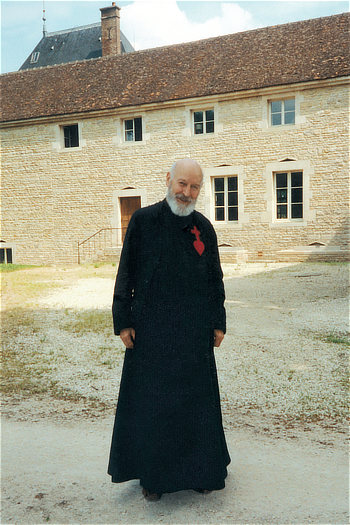
Our Father, at Maison Saint Joseph in 1997, on his return from exile.
“We must not fear the consequences of our service to the Church nor weigh them up against our personal interests, our reputation, or the future of our houses; material difficulties may arise, as well as contradictions and misunderstandings, even the estrangement of old friends, and then the failure, the ruin of the work. None of this can be weighed against a single dogmatic truth. God does not need our success. Rather, He takes interest and joy in our sacrifice!” (Letter to Our Friends, April 13, 1975)
And a little further on, he specified: “The aim of this process would be to identify, amongst the topics under discussion, the minimum elements necessary for full communion with the Catholic Church.”
This work of clarification is precisely what our Father sought to achieve throughout his life without success.
Firstly, during his trial in 1968, our Father asked the Congregation for the Doctrine of the Faith to perform a work of discernment between the two ‘spirits’ that confronted each other during the Second Vatican Council.
The only response our Father received was the obligation to make an act of total, unconditional submission to every act of the Magisterium – past, present and future – whether issued by the Pope, our bishop, or all the bishops of France, without the slightest distinction as to the authority of the act.
Our Father responded with a profession of Catholic Faith, signifying his total and unconditional submission to the Faith of the Church alone, and not to just any particular act of the Magisterium. In response, his writings were declared “disqualified”!
Thirty years later, Bishop Daucourt sought to sanction our Father on the sole ground that he refused to submit to the teachings of the Second Vatican Council, even though they were given in a non-definitive manner. Then, a month later, he performed a volte-face and attacked our Father on other grounds. Why? Quite simply because to admit that a particular conciliar novelty had been presented only in a non-definitive manner was to admit that it enjoyed only a mere presumption of truth, which could be overturned by demonstrating an error! This would leave the door wide open for a discussion with our Father. The bishop hastened to shut it immediately.
Our Father therefore lodged a first appeal with the Congregation for the Doctrine of the Faith. This appeal is entirely based on the precise definition of the ordinary and universal Magisterium as the sole infallible authority, in contrast to those non-definitive doctrines in which, one day, it will be necessary to distinguish between the truths and errors they contain and which coexist within them.
Our Father, in a second appeal, called for the freedom to profess the Catholic Faith to its full extent and implications. “But,” he specified, “regaining and retaining the status quo is certainly insufficient. It is an interim measure to restore harmony and peace. What remains to be done, according to our wishes, is to resume exactly the reconciliation project that was close to being realised in 1978.”
This reconciliation project involved asking our Father’s Roman judges to consider the dispute in its entirety so that the possibilities for an agreement and the paths to reconciliation within the unity of the faith, the diversity of opinions, and the charity of the Church could be explored. This meant leaving it to Rome to draw up the list of points at issue which, in its view, constituted – for each of them, in that year of 1978 – the necessary condition for membership of the Church and for full communion with the Holy Father, whilst placing in the background all matters pertaining to the diversity of opinions, leaving everyone a certain freedom.
Does this not correspond, in the current context, to what Pope Leo proposed, through the good offices of Cardinal Fernandez, to the Priestly Society of Saint Pius X? Namely to highlight “the minimum elements necessary for full communion with the Catholic Church”?
This proposal would have provided an opportunity for a salutary confrontation that would have compelled:
- on the one hand, the Congregation for the Doctrine of the Faith, on its own initiative, to identify clearly, amongst the new laws, those pertaining to a teaching that cannot be rejected if one is, in its view, in full communion with the faith of the Church,
- and, on the other, the Priestly Society of Saint Pius X to draw up a precise and exhaustive list of the major guiding doctrines which, in its view, constitute heretical teachings that one cannot embrace without losing the Faith and thus breaking precisely one’s communion with the Church.
Such a confrontation could be useful for the defence of the Faith in a true and charitable service to the Church. Between the Acts of the Second Vatican Council and the subsequent Acts, we are faced with an incredible mass of texts which, year in, year out, distil this modern conciliar religion of a reformed Church.
In 1993, our Father produced a truly remarkable synthesis of the conciliar religion, based on his study of the Catechism of the Catholic Church (CCC). From it he was able to identify twelve major heresies. The first of these concerned precisely the Magisterium, object of “an abusive extension of the indefectibility and infallibility of the Church in her head, in her pastors and in her people”.
By accepting this confrontation, the Priestly Society of Saint Pius X would have carried out a work of Counter-Reformation. To what extent? Perhaps it would have secured official recognition of its freedom to profess the Catholic Faith without having to assent to dubious doctrines that enjoy no guarantee of infallibility. In doing so, the Priestly Society of Saint Pius X would have highlighted the absolute necessity for the Pope to issue an extraordinary and solemn judgement to settle infallibly the points of conflict that are absolutely irreconcilable.
Instead, just as Archbishop Lefebvre had done in 1976, the superiors of the Priestly Society of Saint Pius X betrayed the work of the Counter-Reformation proposed to them by the Congregation for the Doctrine of the Faith. Even before the battle began, they admitted defeat, preferring – in schism, no less – to safeguard their own interests rather than defend the dogma of the Faith, without which there can be no communion within the Church.
To have this freedom to defend the dogma of the Faith to the point of demanding from the Pope the Truth which he has the power to declare infallibly, one must therefore be small and counted as nothing. This is today our privilege, in fidelity to the fight undertaken by our Father.
Brother Bruno of Jesus-Mary