Centenary of the apparitions in Pontevedra
Jubilee in Lourdes and Garaison
A PILGRIMAGE OF REPARATION
TO THE IMMACULATE HEART OF MARY
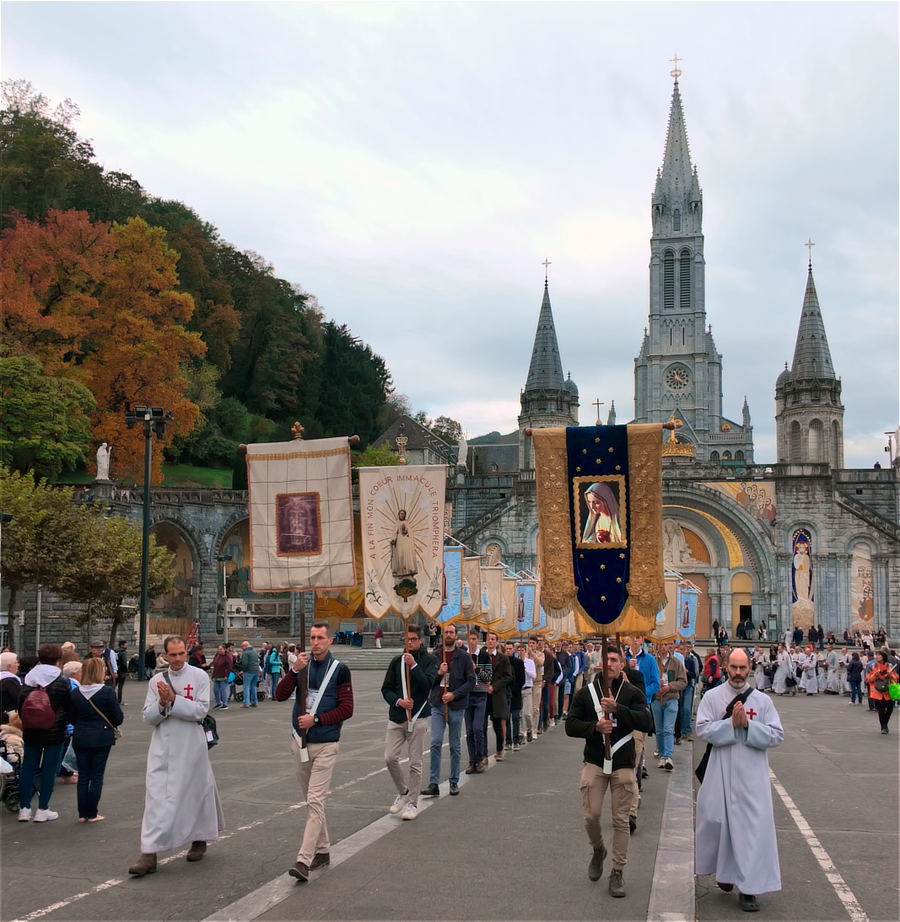
Phalange of the Immaculate,
Let us march alongside her,
To fight the final battle, Against Satan and his law.
Let us immediately commit ourselves under the banner of Mary’s phalanges
So that one day we may be assured of our departure to our true Homeland. (Y. Leca)
ONE hundred years ago, on December 10, 1925, in Pontevedra, Spain, the Child Jesus and His Most Holy Mother revealed to the Church the reparatory devotion of the first Five Saturdays of the month that God wants to establish in the world for the consolation of the Immaculate Heart of Mary and the salvation of poor sinners who are falling into Hell. But for a century now, the hierarchy of the Church has remained deaf to the requests of Heaven. And today, His Holiness Pope Leo XIV is following in the footsteps of his predecessors. On October 11, when celebrating the ‘jubilee of Marian spirituality’ before the statue of the Capelinha, he did not even mention Our Lady of Fatima, demoting the Virgin Mary instead to being merely an icon of human joys and sufferings.
Sixty years ago, faced with the triumph of the Modernist and Progressivist sect at the Second Vatican Council, our Father sounded the alarm: “Heresy is in the Council!” But for decades, his tireless Counter-Reformation struggle and his appeals to the infallible judgement of the Supreme Pontiff have been met with an unprecedented dereliction of duty.
What, then, can be done to restore the dogma of the faith in the Vatican and satisfy the desires of Jesus and Mary?
Our Father was already asking himself this question with anguish in 1982: “What are we to do? A military crusade, an intellectual polemic, an apostolate? If that were the case, how powerless, weak, and unarmed we would feel ourselves to be!”
It was precisely the prayer of the Angel of Cabeço that would provide him with the answer: “Heaven intends to share the work with the earth in these difficult times. It is for us to pray and to beg pardon, and I do not even say to expiate and undertake rigorous penances, of which our cowardice is incapable; simply to prostrate ourselves with confusion for ourselves and our brethren and to beg pardon! That is, to recognise the holiness, the majesty and the authority of our King and of our Queen over all of us, Their infinite goodness and Their mercy, then to confess that the world and even the Church is ungrateful, insolent and provocative in their impiety, their rebellion and their other sins. And then place ourselves between the world and God to implore forgiveness.
“And that will suffice. The rest, the Immaculate Heart of Mary will do; Her Heart alone will be able to do it, and not us, not one of us. It is a mysterious design; it is the will of our Heavenly Father and of His Son Jesus Christ for our century. This Immaculate Heart, this maternal and royal Heart will perform signs and wonders, and She will touch all the prodigal children whom we despair of saving, of bringing back, of converting, and She will do this swiftly without apparent effort, without delay. She will bring them back en masse, as one man, towards Jesus and towards the Father.”●
It was with this intention that Brother Bruno launched the project of a huge Phalangist pilgrimage of reparation to the Immaculate Heart of Mary, for the centenary of Her revelation in Pontevedra. Alas! The small Galician town and its modest sanctuary turned out to be too small and it lacked the adequate material resources to accommodate us. The chaplains of La Salette, a shrine of reparation in France, then closed their doors to a CRC pilgrimage. Finally, Lourdes agreed to welcome us. Brother Michel explained to its rector, whom he had gone to visit, that we were not coming to engage in controversy, but to make reparation to the Immaculate Heart and that we would gladly participate in the celebrations organised by the shrine.
But is it still possible, in the conciliar Church, to venerate the Immaculate Conception through the privileged devotion that God wants to establish in the world, contrary to the minimalism that has prevailed for sixty years and the obstinate refusal of all the successive popes – except John Paul I – to accept this little act of reparation?
It was with this nagging concern, fuelled by a series of ukases from the shrine, that Brother Michel and his assistants set to work to bring Brother Bruno’s project to fruition. It was a tremendous undertaking, both materially and spiritually! Compiling lists of pilgrims, finalising the programme with the chaplains, finding and booking hotels, chartering coaches, printing badges, managing countless special cases, publishing new recordings on VOD, and so forth. Perhaps the greatest success was the rich pilgrimage booklet: two hundred pages explaining the spirit of reparation, guiding our visit to the shrines, and offering beautiful prayers and meditations. Writing, composing, and printing it – what a job! Our sisters took care of the binding, but also made several hundred packed lunches and fifteen beautiful banners of Our Lady of Lourdes. Added to the fifteen others made in 2017 for the centenary of Fatima and our large banners of the Immaculate Heart of Mary, the Holy Face and John Paul I, they would show everyone in what spirit and under what Queen we were placing ourselves!
SATURDAY, OCTOBER 18: PRAYER AND PENANCE
OPENING MASS IN SAINT BERNADETTE’S CHURCH
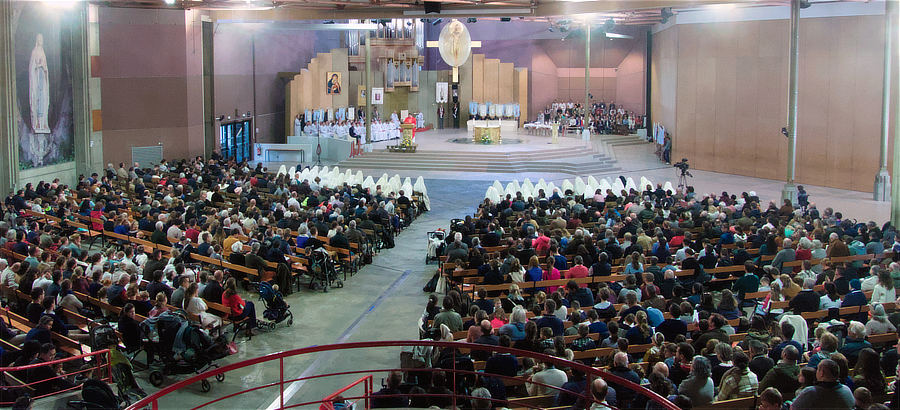
Opening Mass of our pilgrimage at Saint Bernadette’s Church
First gathering of our Phalange
The wide concrete walkways proved very useful for accommodating the hundred or so pushchairs!
Finally, on Saturday, October 18, at half past ten, nearly 1500 friends converged through the grounds of the sanctuary of Lourdes towards Saint Bernadette’s Church, facing the Grotto, on the opposite bank of the Gave of Pau (a “gave” is mountain stream in the Pyrenees). Never before had our Communities and our Phalange been so numerous or, above all, so unanimous, united by our love for the Immaculata. The joy of the “Pilgrims’ Departure Hymn” during the entrance procession, the power of the Credo III, and our recollection during the Our Father helped us to disregard the grey concrete and conspicuous piping system of the building. We were united by our love for the Immaculata, to console Her, and nothing else mattered! Moreover, during the long distribution of Communion, for which a dozen brothers helped the celebrant, we had time to sing all the verses of the hymn “Jésus Enfant,” which so beautifully expresses the message of Pontevedra, imbuing us with the intention of our pilgrimage.
Finally, in perfect order, our thirty-four banners, followed by about fifty brothers, sixty sisters and the throng of pilgrims, processioned out of the church to the words of the hymn, “Queen of France, pray for us!” Our singing, our supplicatory prayer filled the forecourt, drowned out the roar of the Gave, and echoed all the way to the Grotto, to the Immaculata Herself. Brother Bruno had assured us several times that in the institutionalised anarchy in which our country is languishing, our pilgrimage of reparation would be the most useful public demonstration for its salvation. At Lourdes, we wanted to represent our people in fetters, as Gallia pœnitens et devota, loving France, penitent and invincibly attached to Her Queen! This would assure Her that She still has a few faithful hearts, a few devoted souls in Her beloved kingdom.
SAINT BERNADETTE, OUR MODEL.
As we left the church dedicated to her, we were greeted by the statue of Saint Bernadette. She would be our guide for our pilgrimage of reparation, for the example of her life represents the virtues that please the Blessed Virgin. From the moment of the apparitions, witnesses contemplated the reflection of the Immaculate Conception on her transfigured face. Her features suddenly took on a heavenly beauty, expressing in turn the successive sentiments of the Beautiful Lady. And thereafter, throughout her life of self-effacement and self-immolation, her heroic conduct reflected the holiness of her Immaculate Mother. Our Father explained this on February 2 1975, during sermon for the clothing ceremony of our Sister Bernadette of the Most Holy Rosary:
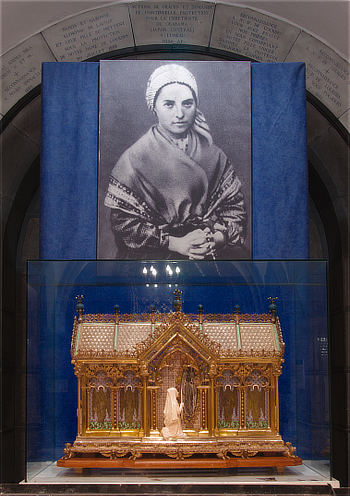
Reliquary of Saint Bernadette in the Crypt
The confidante of the Immaculate is a model for us in entering into reparatory devotion. “O Jesus, I no longer feel my cross when I think of Yours.”
“If, in the early years of our devotion to Lourdes, during our first pilgrimages, we were engrossed by the radiance of the Virgin Mary, it must be said that, as we deepened our understanding of the message of Lourdes, our eyes soon turned from the glory of the Virgin of the Rosary to the eminent holiness of Her little servant. Through her humility, her modesty, her submission to the will of God, which ultimately annihilated her, crushed her, it seems to me that the little child, through love, found herself, as Saint Thomas Aquinas says, on an equal footing with the Virgin Mary. Yes, she was raised by the Virgin, her Mother, her Novice Mistress, so to speak, to such a degree of perfection that, by seeing, studying and scrutinising in detail the life and every word of Saint Bernadette in her convent of Nevers, where she was known as Sister Marie-Bernard, and by meditating on the prayers she copied into her large notebook so as not to forget them and to recite them often, we understand in the child all the virtues of the Mother.”
In Lourdes, the memory of Saint Bernadette is still very much alive, and between two ceremonies at the shrine, we were able to walk in her footsteps by visiting the places where she grew up. Our sisters, always in a group, were divided into four squads. They criss-crossed the town without wasting a minute. Our friends, in extended order, would follow closely a brother to benefit from his explanations. As time was short, some of the most enthusiastic young people, led by a few young brothers, did not hesitate to leave at four o’clock in the morning for Bartrès, where our saint stayed with her wet-nurse, tending her flocks. There, the parallel between the shepherdess of Lourdes and the shepherds of Aljustrel is striking. The same is true of the Boly mill, where she was born, and the Lacadé mill, where her family was placed after the apparitions and which holds so many precious memories. One can savour the same aroma of evangelical poverty, industrious virtues, simple and profound piety, and Christian charity that is found in the homes of the dos Santos and the Martos. We thus gradually discover the predilections of the Immaculata, expressed with hea2venly simplicity by Bernadette as a child: “I love everything that is small.”
HOLY HOUR OF REPARATION IN SAINT PIUS X’S BASILICA
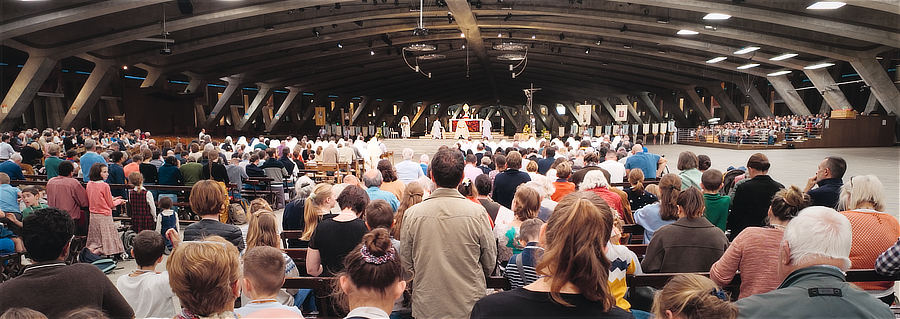
Holy Hour at the Basilica of Saint Pius X
Brother Bruno, at the ambo, announces our pilgrimage intentions
“We want to keep You company, in a spirit of reparation, by meditating on the mysteries of Your Rosary, as You asked us to do a hundred years ago in Pontevedra. Our second intention is to offer this hour of adoration and this chaplet for the Holy Father.”
On December 10, 1925, the Child Jesus beseeched Lucy in her convent at Pontevedra to: “have compassion on the Heart of your Most Holy Mother, covered with thorns with which ungrateful men pierce it at every moment, without anyone to make reparation to remove them.”
It was in the immense Basilica of Saint Pius X that we were able, in the afternoon, to meditate on and put into practice this revelation during an hour of Eucharistic adoration.
Our Father appreciated this colossal underground nave. Its powerful arched pillars reminded him of the ship of the Church battered by storms, its fragility in the face of the dangers that threaten it, atomic war and persecution, but also the firmness of its supernatural faith and hope. Our hymns reinforced this lesson: Brother Henry sublime rendition of the ‘Sub tuum præsidium’, which so well expresses our unwavering confidence in the protection of Our Lady, then the resounding ‘Christus vincit’ that rang out at the moment of the reposition of the Blessed Sacrament, like a tremendous cry of our faith victorious over the darkness of the apostasy that still reigns in the Church.
Before beginning the recitation of the Rosary, Brother Bruno briefly explained the intentions: “O Immaculate Conception, Mother of Your Divine Son, Whom we adore, Whom we want to love through You and in You, in the Sacrament of His love! We want to keep You company, in a spirit of reparation, by meditating on the mysteries of Your Rosary, as You asked us to do a hundred years ago in Pontevedra.
“ ‘Don’t forget to make the offering for sinners,’ Lucy once said to Jacinta when she was suffering. ‘Yes, but first I offer this to console Our Lord and Our Lady, and then I offer it for sinners and for the Holy Father.’
“That is why our second intention is to offer this hour of adoration and this Rosary prayer for the Holy Father, Pope Leo, for his intentions, in the hope of obtaining for him the strength to lead us on the path to Heaven, and for us the grace of the Jubilee, the plenary indulgence, and the purification of our souls.”
This was the first and last time that our Brother would be allowed to speak. In a previous exchange, Brother Bruno had submitted his meditations to the chaplain who was to receive us. He deplored the fact that there was supposedly “no quotations from the Word of God to lead into meditation on the mystery evoked and object of the prayer” and a lack of “references to the message of Lourdes and to the Jubilee Year that the Church is experiencing”. Brother Bruno tried to correct his drafts, but to no avail. It was therefore agreed that before each decade of the Rosary we would have a time of silent prayer to adore Jesus in the Blessed Sacrament. During this time, everyone was free to read silently Brother Bruno’s meditations printed in our pilgrimage booklets. A hymn to the Blessed Virgin broke the silence and Brother Bruno recited a decade of ‘I love Thee Mary’ from the ambo, to which we heartfully and enthusiastically responded. The ceremony concluded with a solemn benediction of the Blessed Sacrament, which the celebrant finally reposed in the tabernacle.
Alas! The next morning, we learned that our chaplain had been scandalised by the freedom our Father had given us to change the words of the Hail Mary. Why? Was that the real reason? We gradually came to understand that, despite our willingness to submit to all their desires and orders, our very existence, our ‘ADN CRC’, and our Counter-Reformation struggle, is unbearable to a portion of the clergy.
We have no power or authority, no force other than the truth that shines forth in our self-effacement. The meditation on the third joyful mystery, the Nativity of Our Lord, showed us precisely the way to victory through humiliation.
“ ‘You are too small to do all that,’ someone said to me yesterday. Was he speaking to me personally, or to all of us who make up this humble spiritual family engaged in a battle of giants that is beyond our strength? O Holy Child Jesus, I believe he was talking to You, so small, so weak and helpless in Your manger in Bethlehem on this Christmas night. I feel reinvigorated in this cold, in this solitude of the last of your faithful, at the thought that we are indeed Yours, like You, since people speak to us as they would speak to You, with the same solid reasons, the same common sense, that simply does not take the mystery into account. For one is never too small when it comes to being, O my God-Child, my Jesus-God, a superadded humanity, a chosen people, a devoted family, worthy at last, by its very smallness, to clothe You in a sparkling mantle of glory! ●
We are therefore very close to the Child Jesus, well placed to understand His appeals and to console our Mother’s Sorrowful and Immaculate Heart.
SUFFERING WITH LUCY AND BERNADETTE.
Sister Lucy ended her account of the 1925 apparition with these words: “After this grace, how could I refuse the smallest sacrifice that God might ask of me? To console the Heart of my dear heavenly Mother, I would be happy to drink the bitterest chalice to the last drop.”
Saint Bernadette had already received from her apparitions the strength to suffer well, in order to ‘earn’ Heaven, which Our Lady had promised her after a life of trials: “I promise to make you happy, not in this world, but in the next.”
Do you know on what date the Immaculata uttered these wonderful words? On February 18, during Her third apparition. If you did not know the answer, you would do well to visit the diorama at the Porte Saint-Michel or the Sainte-Bernadette museum, where one room recounts the eighteen apparitions. We visited it with children whom Brother Paul was questioning and teaching. We can wager that they would have been able to answer our question afterwards!
Even as a child, in the misery of the Cachot or the neglect of Bartrès, Bernadette had shown heroic submission to Providence: “When you think: the good God allows it, you don’t complain.”
Each time we visit the Cachot on Petits-Fossés Street, we are amazed at the smallness of this room, which is miserable despite the fact that it has been neatly roughcasted.
Saint Bernadette remained faithful to her vocation of suffering throughout her life, encouraged at Saint Gildard convent by her confessor, Father Douce: “Remember often these words spoken to you by the Blessed Virgin: ‘Penance! Penance! Penance!’ You must be the first to put them into practice. To do this, suffer everything in silence at the hands of your sisters and your superiors so that Jesus and Mary may be glorified. Ask Our Lord to show you the cross He wants you to bear this year. Bear it with love, fidelity and generosity.”
Our pilgrimage booklet offered us many of Saint Bernadette’s maxims to meditate on. They testify to her acceptance of suffering and, especially, to her devotion to the Way of the Cross. In Nevers, she made it every day, kneeling on the floor tiles in the community chapel.
THE WAY OF THE CROSS ON THE HILL OF ESPÉLUGUES
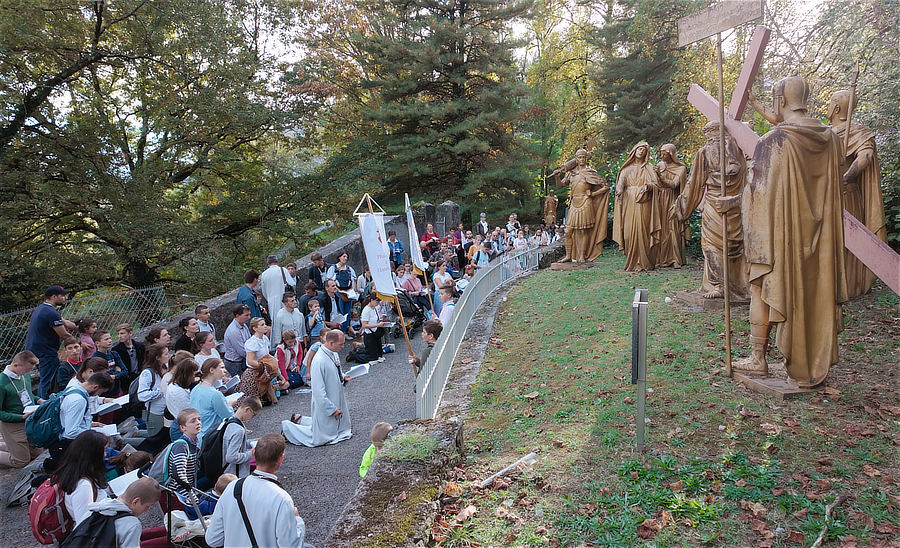
Way of the Cross on the Hill of Espélugues
IVe station, Jesus meets His holy Mother
“In Pontevedra, You returned accompanied by Jesus Your Child, to reveal Your mutual compassion to us. O Mother of Fair Love, O Virgin wounded by the indifference of sinners, make us understand this great duty of compassion, expiation, mortification and penance, the only means, by divine grace, of truly consoling You and regenerating our guilty souls.”
We were now in the best frame of mind to undertake the Way of the Cross, the stations of which are represented in a dignified and evocative manner on the slopes of the Hill of Espélugues. Due to our numbers, we had be split into three groups of four to five hundred pilgrims, led by Brother Michel, Brother Christian and then Brother Bruno. What a technical feat it was to provide voice amplification, loud enough for everyone in the group to hear, but without disturbing the other groups!
This mass of men and women religious, faithful of all ages and conditions climbing behind their banners up a steep mountain dominated by the Cross, what a vivid image of the Third Secret of Fatima, which committed us to unite our prayers with the blood of the martyrs for the consolation of the Immaculate Heart of Mary, the salvation of sinners and of the whole Church “half in ruins”.
Meanwhile, the oldest among us, as well as our seriously ill members, were performing the same act of devotion with Brother Louis-Joseph on the Way of the Cross for invalids that Father Zambelli had built on the north bank of the Gave. What a moving sight it was to see them striving to unite their sufferings with those of Jesus and Mary, in order to make reparation to their one Heart!
At the same time, on the rugged paths of the Hill of Espélugues, our pilgrims kneeling on the stones also willingly offered this sacrifice, encouraged by the meditations written for the occasion. At each station, they linked the sufferings of Our Lord in His Passion with the apparitions of Fatima and the reparatory devotion. Fortunately, on these steep paths, our brothers were able to freely encourage us to pray, to offer sacrifices, and to love the Immaculate Heart of Mary. They echoed the triple call of Our Lady of Massabielle, repeated by the Angel with the flaming sword of the Third Secret, relayed by their little confidantes: “Penance! Penance! Penance!”
IXe STATION: JESUS FALLS FOR THE THIRD TIME
NEARING the end of a gruelling walk, Jesus falls once again, overwhelmed by the ordeal, exhausted by the pain of His wounds. He is dragged down by the weight of the Cross, and His divine Face strikes the ground violently. The cruel thought of our continual sins and of His Blood flowing in vain for a great number of sinners oppresses His Heart with infinite sorrow.
And now, at the Cova da Iria, O Our Lady, divine Messenger of peace, grace, forgiveness and love, You have travelled the earth and given another means of lifting poor sinners from their falls: the most effective, the most powerful, and the most merciful of all.
After the fear of Hell and the practice of the pious exercises of the Rosary and the First Saturdays of the month, You offered Your Immaculate Heart, You presented it to our devotion, to our love, to our consolation. Through it, You assured us, God will draw all hearts to Himself.
You revealed to us the danger of our damnation, but You immediately opened the arms of Your mercy, showing us this easy and appealing way to salvation: “To save the souls of poor sinners, God wants to establish in the world devotion to My Immaculate Heart.” This devotion is the sure pledge of salvation for our souls, but also for Russia, for Christendom and for the whole Church.
O Mary, Who offers Your Immaculate Heart with a certain fear, because You know us to be rebellious, do not allow us to remain ungrateful before this ultimate means of salvation.
Do not allow the Holy Father to despise and reject this maternal grace any longer, but compel all Your children to enter into Your most compassionate Heart, and forgive those who do not believe in it, who refuse to render it a cult, who do not hope in it and who do not love it.
THE PRIVILEGE OF THE CROSS.
On the way back after the Way of the Cross, we enter the sanctuary of Lourdes through the forecourt of the Basilica of the Immaculate Conception. A short detour and you are in the crypt, dedicated to the adoration of the Blessed Sacrament. As soon as you enter, turn right, then left, and you will find yourself in front of the reliquary of Saint Bernadette, dominated by her large, pure portrait. Some had the grace of finding Brother Bruno and were able to respond to the litanies of Saint Bernadette that he was reciting there with emotion. There is nothing like these litanies to get a small idea of the value of suffering.
In her convent in Nevers, Sister Marie-Bernard gradually learned to appreciate it as a grace, even a reward. She jotted down in her notebook: “Jesus, Mary, the Cross, I want no other friends than these.” And also, “O Jesus and Mary, grant that my only consolation in this world may be to love you and to suffer for sinners.”
In the same way, our Father wrote in our 150 Points: “The Cross is the privilege of the Phalange. The Phalangist resolutely enters into the mystery of the Cross, knowing that by renouncing everything and renouncing himself, he is promised a hundredfold in this world and eternal life.” (Point No. 10)
Since our Father consecrated our Phalange to the Immaculate, the cross has become the seal of our belonging to our Queen. On August 20, 1997, when he received the inspiration for this consecration in Canada, our Father dictated this resolution to us: “To work our fingers to the bone, to be loved by the good, hated by the enemies of Jesus Christ and His Holy Mother, ready for all crosses out of love for the Immaculata.”
CANDLELIGHT PROCESSION

The candlelight procession
Together with thousands of faithful, we respond enthusiastically to Our Lady’s request: “I want people to come here in procession” (February 23, 1858). “A procession is the gathering of children coming to their Mother in large numbers, forming one heart to sing Her praises, to pray to Her and to love Her.” (Father Marie-Antoine)
In the evening, at 8:30 p.m., the Phalange began to gather around its banners, near the arcade, in preparation for the night-time procession. Soon, the statue of the Immaculate Conception arrived, a copy of the one sculpted by Cabuchet, the one that Saint Bernadette considered “the least-worst.” Brilliantly illuminated, She catches everyone’s eye and captivates all hearts: ‘Virgo raptrix cordium’!
At 9:05, the introductory words of the procession resounded in French, Italian, Spanish and English. When one considers the crowd of thousands of faithful who gather every evening behind the processional litter of the Immaculate Conception, thirsting after grace, hungering after truth, avid for conversion, one is dismayed by the emptiness of the preaching. It seems that there is no one to lead them to the source of grace, to break the bread of doctrine for them, to call them to prayer and penance. No, those in charge of this Marian procession only know how to press the ‘play’ button so that the loudspeakers on the esplanade reel off pre-recorded slogans in every language: “pilgrims of hope,” “unconditional mercy.” Mercy for what? Hope for what? Our holy religion subject to the whims of conciliar rhetoricians, without sin, without redemption, without Heaven is reduced to a series of empty abstractions. And what of the Immaculate Virgin, the Mistress of the house, Our Lady of Lourdes? Only the Italian soundtrack evokes Her. The others content themselves with adding to their slogan in the last sentence, as if to make up for an oversight: “With Mary, pilgrims of hope.” This choice, this selecting of doctrine, this mutilation of the truth, is precisely what defines heresy.
Fortunately, the singing of the Creed soon resounded throughout the sanctuary and we joined in wholeheartedly with the crowd, while the immense procession, lit by thousands and thousands of candles, set off behind the statue of the Immaculata. At the “Credo in unam, sanctam, catholicam et apostolicam Ecclesiam”, we too set off. And when, at the Gloria or during the refrain of the Ave Maria, we raise our candles with thousands of other faithful to greet our beloved Queen, we feel deeply the joy of being with them, children of Mary and of the Church, it is one and the same!
Among this immense gathering of people, our Phalange stood out for its discipline. We would not be entrusted with any function in any of the Marian processions in which we participated during our stay in Lourdes, but that does not matter: it was our cohesion, our fervour, our very submission, that made us stand out. The Phalange of the Immaculata, meticulously aligned behind its banners, eight abreast, attracted attention and camera flashes!
The immense river of fire flows slowly around the esplanade, processioning around the Calvary of the Bretons behind the statue of the Immaculata, gradually gathering on the forecourt of the Basilica of the Rosary, under the gaze of the crowned Virgin. And we have time, as we recite our Rosary, to reflect on the wonderful reflections transcribed in our Pilgrimage Handbook on the mystery of the Immaculate Conception. First of all, those of Father Marie-Antoine:
“All the doctors, all the saints seemed to have exhausted all their praises, they had filled countless volumes with them, all said that She was pure, that She was holy, that She was without sin, but none of them called Her and above all defined Her as the Immaculate Conception. The more we delve into these three words, the more we meditate on them, the more we discover wonders and hidden treasures [...]”●
How enticing! What wonders? What treasures? Let us read Saint Maximilian Mary Kolbe, who examined this mystery so thoroughly:
“Everything must be done to make the Immaculata better known. Her relationship with the Father, the Son and the Holy Spirit, with the Holy Trinity, with Jesus, the angels and ourselves must be made known. There is an unlimited field of study here. Every grace has passed through Her hands! All this must be presented to souls to nourish them with the Immaculata; and by assimilating Her, these souls will live by Her.” (1935)
How we would love to distribute these teachings to so many avid souls around us who find no one to explain to them the mystery of this Name revealed to us by Our Lady of Lourdes! But Father Kolbe invites us to seek even further, and our Father has set out on the path he has opened.
“Our Lady of Lourdes has not finished Her role. We must return there, kneel before the Grotto and beg the Blessed Virgin to explain to us what we have not yet understood, what we repeat endlessly without seeking any further. And there, I believe, we will find it. We must pray for this.” (February 13, 1999)
And so? We repeat with these saints: Who are You, Immaculata? This is the urgent, perpetual question of the child who loves, who loves Her, and would like to know Her better in order to love Her even more, infinitely.
“She is a creature, but closer to God than the other creatures. The word immaculate is positive. It expresses Her intimate, incomparable relationship with the Father, the Son and the Holy Spirit, to the point that one would think She were divine. She is divine only through the gift of grace, but She was conceived only to be the vessel of election filled with the Holiness of God, as no other creature can be.
“She is related to God, but this relationship is so perfect, it positively implies such holiness that She resembles the Holiness of God, without being so. It is this word ‘immaculate’ on Her virginal lips that makes us understand this. ‘I am the Immaculate.’ She could have left it at that, but She had to make it clear that She is humbly the servant of God by being His creature, an exceptional and pre-eminent creature, His Conception.” (March 2, 1997)
It is only in Heaven that we will fully comprehend this mystery, but already our hearts are drawn to and inflamed by these sublime truths glimpsed for a moment, and we repeat tirelessly: Ave Maria! I love You Mary!
SUNDAY, OCTOBER 19
EUCHARISTIC AND MARIAN CRUSADE
On December 10, 1925, Our Lady confided to Lucy:
“Behold, My daughter, My Heart surrounded by thorns with which ungrateful men pierce Me at every moment by their blasphemies and their ingratitude. You at least try to console Me and say that I promise to assist at the hour of death with all the graces necessary for the salvation of their souls all those who, on the first Saturday of five consecutive months, go to confession, receive Holy Communion, recite five decades of the Rosary and keep Me company for fifteen minutes whilst meditating on the fifteen mysteries of the Rosary, in a spirit of reparation.”
These are the weapons with which we will save our souls and those of our brothers, console our Mother, and reconquer for Her Her beautiful Kingdom. During this second day in Lourdes, the citadel of the Immaculata, a veritable boot camp for Her Phalangists confronting the world and Satan, we were trained in the use of these weapons.
MEDITATION ON THE MYSTERIES OF THE ROSARY
We were scheduled for a second reparatory adoration the next day at 8:15 at Saint Bernadette’s Church. As mentioned above, it got off to a bad start. The priest who was to celebrate the exposition of the Blessed Sacrament approached us and informed us that while we still had the right to sing, we would no longer be allowed to speak. He would therefore read Brother Bruno’s text himself and preside over the Rosary, “using the normal formula”. So it was our way of expressing our love for the Immaculata that was banned from the sanctuary of Lourdes.
Brother Bruno withdrew into the background with such self-sacrifice that most of our friends did not even suspect the atmosphere of unease in which our adoration took place, and they savoured without disquiet the splendour of our songs, the liturgy, and the joy of keeping company with the Immaculate Heart of Mary before Jesus in the Eucharist, according to the intentions formulated in Brother Bruno’s introduction, which the chaplain read to us:
“We adore You, O Divine Eucharistic Heart of Jesus! We know that You are here present, in Your risen Body, Your Blood, Your Soul and Your Divinity, all united in Your unique and perfect Person of the Son of God made man, Who died and rose again, given forever to Your creatures as a saving Victim and as Mediator, as Saviour and as King, Lord almighty and merciful.
“It was You Who appeared in Pontevedra a hundred years ago, commanding us to have compassion on the Heart of our Most Holy Mother, covered with thorns with which ungrateful men pierce it at every moment, without anyone to make reparation to remove them.
“And we fear that, a hundred years later, there is still no one to make reparation, to remove the thorns from Your Heart.
“We, at least, want to try to console You, O our Divine Mother, by keeping You company during this holy hour, as You have asked, by sympathising with You in Your sorrows, by beseeching You to obtain for Pope Leo, for our bishops, our priests, for all the faithful kneeling here before You, forgiveness, mercy and salvation for the Church and for France, a grace we especially hope to receive in this jubilee year. “There is only one thing for us to do,” said Saint Bernadette, “and that is to pray very much to the Most Holy Virgin, that She may intercede for us all with Her dear Son and obtain forgiveness and mercy for us.”
Saint Bernadette had already taken up the pious habit of meditating on the mysteries of the Rosary. “In her prayer,” we are told, “she did not engage in lofty considerations, but was content to contemplate Our Lord in His various mysteries and to apply them practically to the guidance of her life. Among vocal prayers, the Rosary was her favourite.
“The venerable,” testified Sister Casimir Callery, “meditated on the mysteries. One day, I confessed to her that I could not pray; she replied confidentially: ‘Transport yourself to the Garden of Olives, or to the foot of the Cross, and remain there. Our Lord will speak to you, and you will listen to Him.’ ”●
This is precisely how the texts prepared by Brother Bruno led us to contemplate the Passion between each decade of our Rosary. His luminous understanding of the Word of God, inherited from our Father, and his knowledge of the Holy Shroud enriched our meditation, while the teachings of Our Lady of Fatima brought the lesson up to date. Thus, for the Crowning with Thorns of Our Lord, Brother Bruno reminds us that we saw this same painful crown again on June 13, 1917:
“In front of the palm of Our Lady’s right hand was a Heart encircled by thorns that seemed to pierce it. We understood that this was the Immaculate Heart of Mary, outraged by the sins of humanity, seeking reparation.”
“O Jesus, You have an even more ardent desire that She may reign over ‘the whole world, especially France, and every soul in particular’! May She be loved and glorified everywhere! But men did not want this. Everywhere, our Queen is humiliated, debased, and outraged.
“Forgive us, O sorrowful and Immaculate Heart of Mary, and may Your Reign come, through the Holy Father.”
VIDI AQUAM.
During the fifth mystery, at the thought of the pierced Heart of Our Lord letting blood and water flow forth as a sign of the perpetual flow of grace, our minds escape from Saint Bernadette’s church and cross the Gave back to the place where she made another spring gush out with her hands, at the behest of the Beautiful Lady, on the right side of the rock: ‘Vidi aquam’!
“Lourdes is like the Holy City, the heavenly Jerusalem coming down from God,” our Father wrote. “Massabielle is the rock of the blessed Covenant, from which flows the rushing stream in which all peoples must bathe themselves, from which they will drink to be purified and renewed in order to have a share in the Banquet of the Wedding Feast of the Lamb. Multitudes press forward, fraternal, and I bathe myself, I drink, happy to be taken into, to be jostled, lost in this throng that will lead me to Paradise if I remain among all these redeemed, these saved.”●
We had only been able to reserve about twenty places at the baths for our seriously disabled. The availability of a few extra places allowed some additional brothers and friends to take advantage of them as well. The others devoutly performed the water ceremony at the fountains or at the edge of the baths. It was a truly edifying sight to see entire families, sometimes under the guidance of a brother, bathing and drinking while praying devoutly.
The museum of miracles, located in the Office of Verifications building and easy to visit between scheduled activities, was there to attest to the spectacular power of the Immaculata and the wonders She deigns to perform through this miraculous water.
CONFESSION
But more than the healing of bodies, it is the healing of souls that Our Lady wants to accomplish in Lourdes. In one of the sermons that had been made available to our friends on our VOD site to help them prepare for their pilgrimage, our Father drew a parallel between the immersion of baptism and that of the baths which renews its grace:
“The Blessed Virgin wanted to make Lourdes a place of conversion. You have to go down into the water, as in the water of Baptism. How many people have I seen wanting to be baptised again! We tell them that it is not necessary, that they only need to go to Confession. Yes, but I would like to feel symbolically that the water is flowing over me to wash all my sins away and that I come out of there as a new creature, with my new baptismal robe, never to lose it again.” (February 11, 1995)
To make water ceremony explicit, our pilgrims flocked to the confessionals. The chaplains noticed a sharp increase in the number of penitents during those two days!
But the confession that Our Lady asks of us every first Saturday is still only one step. It is Her ‘little white barrier’, as our Father explained so beautifully in a sermon on September 8, 2000. Like the ticket-puncher in the metro of yesteryear, the Blessed Virgin asks us for our ticket, our ticket of Confession, to open the door to her garden, to prepare us to receive Communion, the greatest of the Sacraments.
What to ask of the Blessed Virgin
The Immaculate Lily, Father Marie-Antoine de Lavaur.
YOU can ask Mary for anything; through Her prayers She can do as much as God can through His power.
The Fathers of the Church call Her: Omnipotentia supplex. Go to Mary, says Saint John Damascene, go to Her with complete confidence: ask Her for whatever miracles you want, there is nothing She cannot do; She is the great laboratory of God’s miracles: Miraculorum officina.
But it left to us to understand which miracles are most important for us to ask for; it is left to us to understand that the soul must come before the body.
How blind we are: we go to our Mother in Heaven and we do not ask Her for the things of Heaven! We ask Her for the health of the body and we do not ask Her for that of the soul; we ask Her for riches, for the consolations of time, and we do not ask Her for the riches and joys of eternity!
That is why the Church puts this wonderful prayer in our mouths: “My God, teach us first what we should desire and ask for, and grant our prayers.”
If this is so, we will henceforth make our pilgrimages with intentions that are always elevated, always holy, and always pure: if it is a matter of temporal things, let us ask for nothing in an absolute way, let us entrust ourselves to the wisdom and goodness of God and simply beg Mary to ask Him for what is most useful to us, and Mary, Who is never invoked in vain, will always obtain it for us.
Let us not forget that bodily illnesses are often useful for our salvation: they serve to detach us from the earth, to make us look within ourselves, to atone for our sins, to embellish our crown.
But illnesses of the soul only serve our misfortune and damnation; Mary, if we ask Her, will always heal us of them.
COMMUNION
At ten o’clock, the shrine’s outdoor Sunday Mass at the Grotto began. Our pilgrims made up only half of the large congregation. Our banners, lined up to the left along the rock face, preached the reparatory devotion to all the people of God! Filled with the teachings of our Father, preciously recorded in our booklet, we were determined, through our participation in the Holy Sacrifice and through our Communion, to console the Immaculate Heart of Mary greatly. The heart-to-heart communion is so important to Jesus and Mary that if, at that moment, we feel some compassion for the Blessed Virgin, so offended by so many outrages, sacrileges and indifference, and offer Her what little love we have in reparation, and not only for our own good, we obtain floods of grace for the salvation of sinners, of whom we are the first.
It is not difficult to enter into this intention: “Our Lady of Fatima looks sad and shows Her Heart pierced with thorns. These are all the blasphemies and insults She receives from sinners, and sinners are even in the Catholic Church. We look at the statue, we see the Blessed Virgin and we feel pity for Her. These are burning wounds. It is like a sword in our Mother’s Heart, like a mother insulted by her children. Jesus cannot bear it; so we intercede like children who embrace their mother to console Her because wicked people have struck Her. You do not have to look very far to find them.” (March 1, 1997)
Alas, indeed! For the distribution of Holy Communion that day was very poorly organised at the Grotto for the faithful in attendance. And this, amid the indifference of the clergy. The celebrant even finished Mass without worrying about the last faithful who had not yet received Jesus in the Eucharist and who were therefore deprived of the heavenly Bread on that Sunday! In Lourdes, never has the gap between the clerical administration and the poor faithful seemed so broad. And we understood better the complaint of Our Lady of Pellevoisin: “What grieves Me most is the lack of respect shown to My Son in Holy Communion.”
“The angel of Fatima said to the children: ‘Consoled your God.’ We must console Jesus, and console Mary. It is a wonderful thing. Just as we console our mother when she cries. It brings sweetness to our hearts to be able to console her. Here, we must console the Blessed Virgin, Who is our Mother in Heaven. ‘O my poor little Mother, how sinners have mistreated you, but have mercy on them.’
“Asking Her to have mercy on them pleases Her and allows Her to intercede for sinners before the great God in Heaven. If the Blessed Virgin weeps before Her heavenly Father and asks forgiveness for sinners, they are sure to go to Heaven.” (ibid.)
At the end of Mass, the Ave Maria of Lourdes was sung. What a joy it was to sing it here, at the foot of this blessed rock! Our enthusiasm was so great that when the cantor stopped after a brief verse, ten, a hundred, a thousand voices took up this song of love: Ave, ave, ave Maria! The throng of pilgrims was unanimous, each singing the verse in his own language before joining in the common refrain: Ave Maria!
It was at this moment that our banner formation left the Grotto in procession and set out for the information booth that had been assigned to our group near Saint Joseph’s Gate. Under the leadership of Brother Frederic and Brother Mary-Bruno, they proceeded in such good order that their movement spontaneously drew us all in their wake: the brothers first, then a few hundred Phalangists. Processioning along the bank of the Gave, passing through the large archway, we burst onto the Basilica of the Rosary’s forecourt, still singing our Ave Maria at the top of our voices, under the delighted gaze of the pilgrims. There was a brief moment of hesitation: what were we doing and where were we headed? At the behest of Brother Michel, immediately echoed by our ceremonialists, the banner carriers placed themselves at the feet of the crowned Virgin, facing the brothers and Phalangists who come to a standstill in a semicircle. How beautiful the Immaculate Conception seemed to us then! It was this statue that was solemnly crowned on July 3, 1876, in the presence of thirty-six bishops and archbishops and a huge crowd of people. We know that this ceremony greatly pleased our Mother in Heaven because, that same evening, She appeared to Estelle Faguette in Pellevoisin, saying to her: “I have come to end the celebration.”
We, in turn, had just come from finishing Mass at Her grotto. When the singing ended, Brother Bruno intoned our Act of Consecration to the Immaculate Conception, which we usually recite in thanksgiving after our communions. This public and solemn renewal of the Phalange’s consecration to its Queen, in this providential improvisation, was one of the most moving moments of our pilgrimage of reparation!
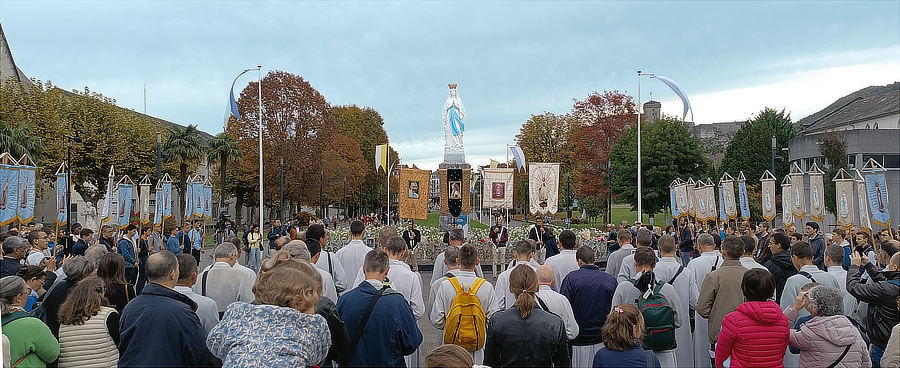
After Mass, the Phalange renewed its consecration to the Immaculate Conception at the foot of the crowned Virgin: “Above all, dispose of me as You wish, so that what is said of You may finally be realised: ‘The Woman shall crush the head of the Serpent’; and also: ‘You alone shall vanquish all heresies throughout the whole world’.”
THE BASILICAS – FATHER PEYRAMALE
Our Father remarked that it was Our Lady Herself Who was eager to draw Her Son, Jesus-Eucharist there to Lourdes: “It is You Who asked for a chapel in this wild and unloved place, as in Nazareth You had already invited God by Your prayer and drew Him to the holy tabernacle of Your Flesh. It was to give Him in love to generations of brethren and pilgrims.”●
Once Father Peyramale, parish priest of Lourdes, knew the identity of the Lady of Massabielle, he became the enthusiastic promoter of the construction of the “chapel” She had requested.
One day, while supervising the work, he was seen tearing up the architect’s plans and throwing the scraps into the Gave. “I’ll have you know,” he said to him, “we do not need a small chapel here; we need something as great as the Immaculate Conception. And if the expense frightens you, know that She Who brought forth this living spring from this rock is powerful enough to bring forth gold from it.”
The result of so much effort is a marvel of architecture and piety, “a work of great magnificence and immense labour” (Saint Pius X). The upper basilica, the crypt and the Rosary basilica are harmoniously connected by two ramps that embrace the vast forecourt and lead to the long esplanade, which is ideal for processions. The statue of the crowned Virgin reigns over this complex, which is entirely dedicated to Her cult. In the rosy light of dawn or under the fires of twilight – for Providence had blessed us with favourable weather – the spectacle was splendid. And in Lourdes, where everything speaks of the Immaculate Conception, aesthetics lead directly to mysticism.
Several groups of our pilgrims also went to Lourdes’ Sacred Heart parish church, which Father Peyramale also built. Despite the restoration work presently underway that hindered access to its crypt, they managed to gather there at the tomb of this obscure servant of Mary Immaculate.
In the early afternoon, we had a bit of free time that allowed us to finish our visits to the sanctuary and the town.
So let us first join our friends visiting the Upper Basilica, dedicated to the Immaculate Conception and consecrated in 1876. In a very pure neo-Gothic style, it elevates the soul to prayer. Its stained glass windows, in particular, are remarkable. The lower windows recount the apparitions, corresponding to their figurative representations in the Old Testament. As for the upper stained glass windows, they evoke the mystery of the Immaculate Conception. One of them caught our attention in particular: it showed this dogma being introduced into the Creed! Here we have an irrefutable confirmation in tradition of the innovation that our Founder, Father de Nantes, made when he added the Immaculate Conception to the Creed, and for which he is so often criticised.
Let us now descend into the Roman-Byzantine style Basilica of the Rosary, consecrated in 1901. Very quickly, our gaze is drawn to the monumental mosaics representing each of the fifteen mysteries of the Rosary. It is not difficult to meditate for a quarter of an hour and then recite the Rosary to keep the Immaculate Heart of Mary company, which is what she asked for in Pontevedra!
THE ROSARY
We were expected at the Grotto to join in the recitation of the Rosary. A sweet consolation awaited our Brother Bruno there. Indeed, a man in the crowd, hearing his name spoken, recognised him from afar and made his way to him. Leaning close to his ear to make himself understood, he introduced himself: “I am Algerian. I converted from Islam after reading your books on the Qur’an.” He had been baptised at Easter, while his wife, who accompanied him, was still a catechumen. In more than sixty years of studying the Qur’an, this was the first time our brother had received such a testimony. This conversion alone would justify the enormous work that he had begun under our Father’s direction, to establish a scientific translation. Brother Bruno gave this new spiritual son his pilgrimage booklet, in order to complete his conversion by introducing him to devotion to the Immaculate Heart of Mary.
Our Superior General had decided to organise this pilgrimage to console Our Lady, and She clearly wanted to show Her satisfaction by compensating him for his troubles!
This anecdote underscored the scandal of the interfaith colloquium that was being held at the same time in the sanctuary. It was announced on all the information boards: “Christians and Muslims, pilgrims of hope.” Clearly, two religions are clashing within our one Church.
On that Sunday, the Rosary at the Grotto was presided over by Bishop Micas of Tarbes-Lourdes. His short introductions to each decade were a real comfort to us. For example, for the fourth glorious mystery, he exhorted us in these terms: “As we contemplate this mystery, we see Our Lady being raised to the glory of Heaven, in body and soul. She who promised Bernadette the happiness of the other world already resides there and awaits us there, each and every one of us. It is in the mystery of Her Assumption that the Blessed Virgin watches over our country of France. In this decade, let us pray for the intentions of our country and of the Church it serves. May Our Lady of the Assumption revive our faith, sustain our hope and increase our charity tenfold.”
On the other bank of the Gave, the statue of Saint Bernadette, kneeling and reciting the Rosary during the last apparition on July 16, her gaze fixed on the Grotto, reminded us that she was unwaveringly attached to her Rosary. And this was true even before the apparitions. Did she not once say, referring to her childhood, “I knew only my Rosary”? Pilgrims who visited the Cachot were able to venerate her two-penny Rosary beads; but why has the large, edifying Rosary beads that used to adorned the mantelpiece been replaced with a modern crucifix in a vaguely neo-medieval style that Bernadette had never seen in her life?
Our Lady Herself, during the twelfth apparition on March 1, insisted that Her confidante should not use any Rosary beads other than her own, however poor it was. Our Father explained the reason for this: “It is a kind of sacramental and should be recommended to us. When we see that a person is very attached to his Rosary beads, it is not without reason; there are many reasons. This Rosary becomes, between the Virgin Mary and the person who holds it, a bond of spiritual communion.”●
Sister Marie-Bernard remained faithful to the Rosary at the convent. The nun who knew her best and most intimately in Nevers, Mother Éléonore Cassagnes, testified: “She recited the Rosary with angelic piety, and she always had it in her hand when she walked through the cloisters; this inspired us, said the novices, to do the same.”
Now, since Fatima, the daily recitation of the Rosary is no longer a matter of personal devotion, but is the will of Our Lady, repeated at each of Her apparitions. The Blessed Virgin has given it new effectiveness in the battle of the end times through which we are living. This is why Sister Lucy would seize every opportunity to ask the Holy Father to recognise the Holy Rosary as a liturgical prayer: no longer just an optional devotion left to the free discretion of each individual, but an official prayer of the Church, on the same footing as the Liturgy of the Hours.
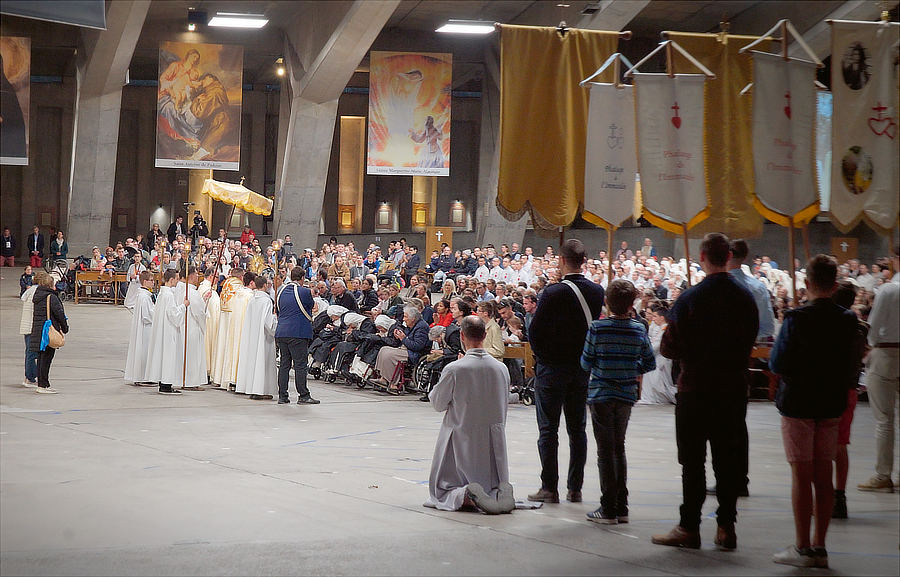
Eucharistic procession
In the Basilica of Saint Pius X, at the end of the Eucharistic procession, Jesus in the Host blesses the sick and the crowd of pilgrims; here, Mother Lucy and our sisters. Two doctors follow the Blessed Sacrament to be witness to any miraculous healings.
“Son of David, have mercy on us!
Lord, let me receive sight!
Lord, let me walk!
Lord, heal me!”
THE EUCHARISTIC PROCESSION
After the Rosary, we crossed the Gave to go to the podium of Eucharistic adoration, from where the procession of the Blessed Sacrament departs. This is one of the great devotions of the pilgrimage to Lourdes. In this blessed sanctuary, perhaps more than anywhere else, one can understand the mysterious association of prayer to Mary and Eucharistic worship. After exposing Jesus in the monstrance for the adoration of the congregation, the celebrant reminded us: “At the feet of Jesus, we are in the company of Mary, the first worshipper of God made flesh, the first tabernacle, the first monstrance.”
More profoundly, in 2008, Father Raymond Zambelli, then rector of the shrines of Lourdes, explained in an editorial that Brother Bruno enthusiastically commented on: “By bringing the Gospel to men in its simplest form, the Rosary, Mary in fact offers us Christ, since the Gospel is Christ. In Lourdes, for many reasons, not all pilgrims can receive the Eucharist, but all can receive from Mary Christ Who is mysteriously present in the Rosary and represented by this cross which designates Him as the Saviour of mankind.”●
This is the charter of an authentic pastoral ministry on the peripheries of the Church, popular and Marian! Sister Lucy summarised it in a bold statement: “The prayer of the Rosary is the most accessible to all, rich and poor, learned and ignorant alike. It should be like spiritual bread for everyone.”
This was indeed the bread that Saint Bernadette asked for in her prayer to Jesus in the Blessed Sacrament, which our pilgrims meditated on while silently adoring Jesus in the Eucharist.
O Jesus, give me, I pray, the bread of humility, the bread of obedience, the bread of charity, the bread of strength to break my will and merge it with Yours, the bread of interior mortification, the bread of detachment from creatures, the bread of patience to bear the pains that my heart suffers. O Jesus, You want me crucified, fiat! the bread of strength to suffer well, the bread of seeing only You in everything and always.
At the signal from the masters of ceremonies, the procession set off. This procession cut a fine figure! Our banners lead the way, waving in the wind, followed by the impressive battalion of our Communities of Little Brothers and Little Sisters of the Sacred Heart, who were given pride of place in the sanctuary’s video presentation. Then came the faithful, more than half of whom were our pilgrims. Finally, the clergy and Jesus in the Eucharist under a canopy carried by four family men from our Phalange.
The layman who was supervising the major ceremonies at the shrine that day congratulated the brothers in charge of our banner bearers: he had rarely seen such a beautiful pilgrimage! Likewise, at the sight of our united, fervent group and such good fruits of devotion, upright souls recognised that they came from a good tree. Like Nicodemus of the Gospel some of them discretely declare themselves.
After crossing the Gave, the procession entered the esplanade, heading towards Saint-Michel’s gate and the Calvary of the Bretons: the cross grew larger on the horizon. The prayer of Saint Bernadette follows the same direction:
Jesus, Mary, the Cross, I want no other friends than these. O Jesus, keep me under the standard of Your Cross. May the crucifix be not only before my eyes, on my breast, but in my heart, living within me. May I myself be that living crucified one transformed into Him through the union of the Eucharist, through meditation on His life, on the most intimate feelings of His Heart, drawing souls, not to me but to Him, from the top of that Cross where, alive, His love has bound me forever.
Finally, in gusts of wind, we slowly enter Saint Pius X’s Basilica for the rite of blessing the sick. What a moving ceremony, what an act of faith! Watching the celebrant bless the sick and then the groups of pilgrims with the Blessed Sacrament, we are reminded of the multitude of miracles that have occurred on this occasion throughout the history of the shrine of Lourdes. For example, the healing of Gabriel Gargam, which Brother Bruno recounted during the Congress to stimulate the faith and hope of our friends. Two doctors follow the Blessed Sacrament in order to witness these wonders.
Like the candlelight procession, the procession of the Blessed Sacrament in Lourdes was born out of Father Marie-Antoine’s burning faith.
During the national pilgrimage of 1886, just as the blessing of the Blessed Sacrament was about to be given and the deacon was preparing to place the Host in the monstrance, the ardent Capuchin stepped forward: “When the Blessed Sacrament is in the Grotto, we have noticed that there are more healings. Have faith. Here comes our God: Benedictus qui venit in nomine Domini.
“This morning, there were nine healings. The happy privileged ones accompany Our Lord. But nine is not enough; we need twelve to represent the procession of the Apostles before the Saviour. Let us ask, with great faith and bitter repentance for our sins, for three more healings. The Blessed Virgin will obtain them for us. Kneel down, kiss the ground, and raise your arms in the form of a cross!”
The tone is impressive.
“My brothers, cry out to Him as the crowds of Judea did: Son of David, have mercy on us!
“ ‘Have mercy on us,’ cried the crowd.
“ ‘Lord, let me see! Lord, let me walk! Lord, heal me!’ ”
“We prayed, we cried out for mercy. And at the moment of blessing, it was not three sick people, but four who came forward from the baths, healed. There would be thirteen accompanying Our Lord, as the Queen of Apostles also wanted to have her representative in this new apostolic procession.”
Nearly a century and a half later, we in turn repeat “Kyrie eleison” as Jesus in the Eucharist passes through our ranks. But we do not ask first for the healing of our sick, who are placed in the front row, in their wheelchairs, so edifying. No, as we are thus closely mingled with the pilgrim crowd, fully integrated into the mystical body of the Church, it is for the healing of her sick body that we implore. And, more particularly, we ask for grace for our Holy Father Pope Leo XIV, blind to the causes of the ruin of the Church and also afflicted by the same doctrinal errors as his reformist predecessors. Lord, have mercy on us! Our Lady of Lourdes, heal us!
As we watched the Holy Host in the monstrance pass through the crowded esplanade and then the wide aisles of the Saint Pius X’s Basilica, we felt the same sentiments as those of the young Father de Nantes during his pilgrimage on July 16, 1958:
“Lourdes is a holy city, like Vézelay, Le Puy-en-Velay and so many others in the Middle Ages. It is, in one point in space, a gathering of the Church, an image of the immense Christian community (...). Jesus passes constantly through this crowd, the Eucharist is distributed and adored everywhere: as He passes, people kneel, asking for healing and forgiveness with faith. He is there among His own as one who serves. No one is surprised to see Him so close, so mingled with them. The Holy Spirit breathes being, life and movement into everyone. It is He Who gives the Church her form, these masses of all languages and nations, as if they were a single parish.”●
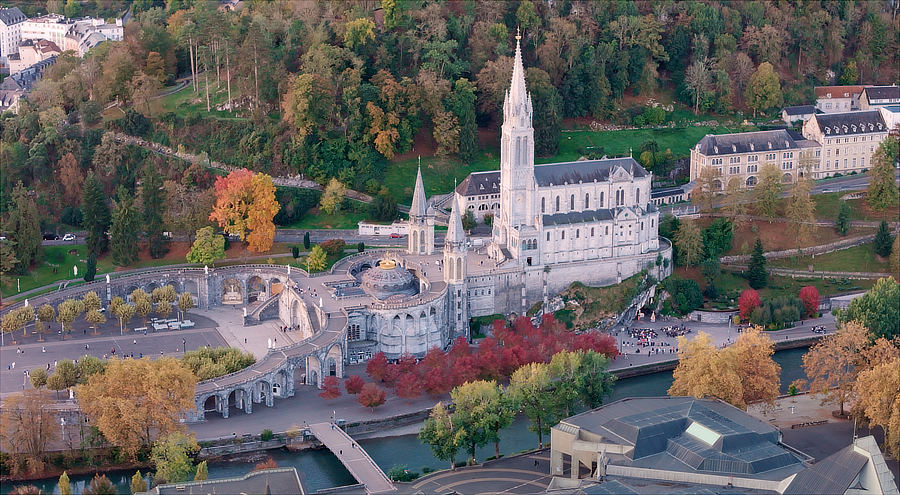
“Tu es Petrus et super hanc petram ædificabo Ecclesiam meam”
It is on the rock of the dogma of the Immaculate Conception that the Holy Father will restore the Church, more beautiful than ever, just as the basilicas of Lourdes are magnificently founded on the rock of Massabielle.
CANDLELIGHT PROCESSION
In the evening, we were back for the candlelight procession. In the end, we took part in four of them, each time with a slightly more well-informed eye, but without our wonder at the sight of this cosmopolitan but fraternal multitude, gathered together by love for the Immaculate Conception, ever diminishing.
“We mingled with this crowd of believers, praying, hoping, loving,” continued our Father. “There is nothing more beautiful on earth than these two works of the Holy Spirit, so similar to each other, as befits a Mother and Her daughter: the gentle and compassionate Virgin, this Church which is Her child (...).
“Those who are animated by true faith cannot remain insensitive to this spectacle: this crowd is too visibly human for reason to distrust and fear the illuminism or hypocrisy of fervour; but this crowd is so happy in its sorrows, confident in its distress, fervent with candour, heroic with simplicity, that the heart admires in it the gift of God, the grace and beauty of the Bride of the Word, the superhuman power of the Virtue of the Most High. This can be seen at the grotto, at the baths and fountains, at the Confession Chapel and during solemn Masses, in the underground basilica, near the countless dear ill people during the procession of the Blessed Sacrament, and finally in the night illuminated by thousands of candles. I do not know why tears flow nor why the depths of the soul are overawed by this sight; it must be that man cannot see the divine so closely or touch the heavenly mystery without dying, without the soul flinching. Make of it what you will. (ibid.)●
These lines date from the last months of Pius XII’s pontificate. Since then, the Council has brought about the triumph of Modernism and Progressivism in the Church and curbed Marian devotion. Apostasy has overwhelmed Rome and swept through the whole Church, emptying shrines of their pilgrims. In the City of the Immaculate Conception itself, a bishop of Tarbes proclaimed on the fiftieth anniversary of the Council: “In Lourdes, there is no message!” Access to the baths has been drastically controlled and brought up to the sanitary standards of a socialist State.
But here is the wonder, the miracle: after sixty years of diabolical disorientation, every evening thousands of faithful continue to gather –under the leadership of a clergy who are often foreign to their piety – to acclaim the Immaculate Conception. The introduction in Italian rightly reminded us – and unfortunately only the Italian translation – that this act of worship is the Church’s response to the request of the Beautiful Lady of Massabielle: “Go and tell the priests to build a chapel here and that people are to come here in procession.” The faithful of 2025 who wave their smartphones are undoubtedly fewer in number, perhaps less devout and more distracted by the siren calls of the world than in 1958, but they remain faithful every evening to this rendez-vous set by Our Lady. Brother Bruno then exclaimed with delight: “The Blessed Virgin asked for processions, and She has them, every evening!”
THE CORNERSTONE OF THE CHURCH.
Our Father continued his letter: “As I write, the procession is coming to an end. The Creed has just been intoned. Ten, twenty thousand voices are singing it. This proclaimed faith is not the most powerful voice in Lourdes, but that of God Who responds to it: God is at work everywhere here.”
Lourdes therefore remains the citadel of faith against which Satan will not prevail, the pledge of the rebirth of the Church, of the restoration of her ruins, on the foundation of the dogma of the Immaculate Conception.
We have never ceased to pray for the conversion of the Pope, the Vicar of Christ. Our Lady of Fatima indeed wanted to make the salvation of the Church depend on his faith and obedience: “Tu es Petrus et super hanc Petram, ædificabo Ecclesiam meam.”
But as we join the unbroken line of pilgrims who pass through the back of the Grotto to get closer to the One Who descended there and revealed Her Name, touching and kissing this cold, hard rock, we also whisper: “Super hanc Petram, ædificabo Ecclesiam meam.”
The Immaculate Conception is the stumbling block on which Her enemies stumble, reveal themselves and are destroyed. We have seen this clearly during these two days: in Lourdes, our love for Mary has brought about a discernment of hearts!
The Immaculate Conception is also the cornerstone on which the restoration of the Church and the dogma of the faith will be founded. Saint Pius X already taught this in his encyclical Ad Diem Illum Lætissimum: “Yet let people believe and confess that the Virgin Mary has been from the first moment of Her conception preserved from all stain; from that point, it is straightway necessary that they should admit both original sin and the rehabilitation of the human race by Jesus Christ, the Gospel, the Church and finally the law of suffering. By virtue of this, rationalism and materialism are torn up by the roots and destroyed, and there remains to Christian wisdom the glory of having preserved and defended the truth.”
Let us allow our Father to conclude: “The Immaculate Conception is God’s secret weapon. If people knew what the Immaculate Conception is, if the Church discovered this mystery that the Blessed Virgin entrusted to us and with which we have done nothing, today or tomorrow, the world would be converted.” (February 13, 1999)
MONDAY, OCTOBER 20: PILGRIMAGE TO GARAISON
FROM GARAISON TO LOURDES
Why make a pilgrimage to Garaison? To understand this, we must first answer another question: why did the Immaculate Conception choose to reveal Her Name and distribute Her largesse precisely in Lourdes? Because She possessed in Bigorre a land that was well-disposed and long irrigated by the living water of Her grace.
In 1062, Count Bernard I of Bigorre dedicated his domain to Our Lady of Le Puy. In 1515, while Luther was plotting his attack on the Church and her faith in Germany, the Virgin Mary appeared to a shepherdess, Anglèse de Sagazan, near a fountain in Garaison. She promised to bestow Her gifts there. This land was, however, perhaps the most notorious in the whole kingdom of France, a wild moor reputed to be haunted by the Devil: the Moor of the Goat. Nevertheless, it was this place that Our Lady chose to take possession of, in order to establish a bulwark for the faith and a living source of Her graces and mercies. It was She Who kept Bigorre in the Catholic Faith, unlike neighbouring Béarn, which was subjected to the tyranny of the Protestant queens of Navarre.
In 1586, however, the region was ransacked by a Calvinist captain who added to his crimes by throwing the wooden statue of Our Lady of Piety, venerated in the sanctuary, into a large bonfire. “The fire burned for more than two hours without causing the slightest damage to the holy image,” Chaplain Étienne Molinier wrote in 1630.
This striking miracle heralded the rebirth of the sanctuary, which began in 1604 with the arrival of Pierre Geoffroy in Garaison. This zealous priest revived the pilgrimage and was soon appointed ‘first chaplain’ at the head of twelve priests, for whom he drew up a rule in the spirit of the Council of Trent. It is to him that the sanctuary owes its current appearance, with its courtyard of honour bordered by the façade of the Jesuit-style chapel and the vast chaplains’ house. Garaison thus became a major centre of the Catholic Counter-Reformation, influencing the whole of south-western France until the French Revolution.
The sanctuary was then devastated once again: the chaplains’ property was sold, the chapel deconsecrated and the artistic treasures squandered. The chaplains refused to swear allegiance to the Civil Constitution of the Clergy and most of them went into exile in Spain. A few hid in the surrounding countryside.
Our Lady did not abandon Her fief in Garaison. In 1835, the Bishop of Tarbes bought back the estate, wishing to make it a centrepiece of his plan to restore Christian life in his diocese. He installed Father Jean-Louis Peydessus there, at the head of three other priests, with the mission of turning this sanctuary, ruined by the Revolution, into a radiant centre of spiritual and Marian life. Immediately, pilgrims flocked from all over, in their thousands! On some days, the chaplains distributed six to eight thousand communions, which meant just as many confessions! They also undertook the work of parish missions and were soon charged by Bishop Laurence with reviving other Marian shrines in the diocese.
This worthy bishop once said, pointing to the fountain of the apparitions in Garaison: “It is from here that the graces of my diocese come and will always come.”
It so happened that in February 1858, Bishop Laurence was in Garaison when he was informed of the apparitions at Lourdes. He recognised this as Heaven’s response to his efforts to restore Marian devotion in his diocese. Announcing the forthcoming coronation of Our Lady of Garaison to his diocesans, the bishop also explained to them: “Heaven seems to have been pleased with the zeal that this diocese has shown and the sacrifices it has made over the past thirty years to restore or rebuild those sanctuaries of piety that our ancestors had erected in honour of Mary and which the bloody events of the end of the last century had destroyed or placed in secular hands. Therefore, the Blessed Virgin has just granted it a new and very remarkable favour: Her apparition in the grotto of Massabielle, near the town of Lourdes.”
The coronation ceremony took place on September 17, 1865, in front of forty thousand pilgrims and five hundred priests. In Bishop Laurence’s mind, this day of triumph was the song of gratitude that the diocese addressed to Our Lady for the gifts She had promised to the little Anglèse and which She had so liberally spread throughout the Bigorre region.
Thus, Garaison was Mary’s first smile and a long preparation thanks to which the little and the humble ones from among the people would enthusiastically welcome the message entrusted to Bernadette: “I am the Immaculate Conception.”
For several months, Brother Michel had been planning to conclude our great pilgrimage of reparation with the brothers and sisters in a more intimate sanctuary. One thing led to another, and we invited our friends and family to join us. In the end, nearly a thousand pilgrims followed us for one more day, to be sure not to miss any of the spiritual goods so generously dispensed by the CRC during these special moments of pilgrimage.
FROM MONLÉON TO GARAISON

One of our groups of pilgrims following the path of the first procession that the inhabitants of Monléon made from Monléon to Garaison after the miracle of the loaves had convinced them of the truth of the Blessed Virgin’s apparitions to Anglèse de Sagazan.
Before dawn, four coaches and more than two hundred cars left Lourdes heading west. Eighty kilometres away, they unloaded their passengers in the village of Monléon-Magnoac, in a studied ballet of cars designed to avoid crossing paths on the narrow roads of this remote countryside. It was a delicate manoeuvre, but it was successful thanks to the good coordination of the volunteers from the sanctuary of Garaison, assisted by our brothers from Fons, Frébourg and Magé. Once everyone had gathered, divided into four groups, we set off for Garaison, five kilometres away, under an overcast and threatening sky.
This route was not insignificant. In 1515, it was the route taken by the first procession honouring Our Lady in Her new domain. The fountain was located in the parish of Montléon. When Our Lady appeared to the little Anglèse de Sagazan, who was tending her flock near a spring, She said gently to her:
“Fear not, I am the Virgin Mary, Mother of God. Go tell your father to inform the Rector of Monléon that he must build a chapel here, for I have chosen this place and will bestow my gifts here."
The girl told her parents what had happened, and the good father Sagazan hastened to take the message to Monléon. The inhabitants did not believe him, nor did they believe him the next day when the apparition returned and repeated Her request, and the good peasant repeated his message.
On the third day, however, several people accompanied Anglèse and, marvel of marvels, although they did not see her heavenly visitor, they all heard Her voice! Even more indisputable was the fact that the unsavoury black bread that the shepherdess was carrying in her bread basket was transformed, oh miracle, into delicious white bread. The Blessed Virgin told the shepherdess to tell her parents, who were then in extreme poverty, that they would find their chest filled with the same wonderful bread. This was immediately verified!
The delighted witnesses immediately hastened to Monléon, spoke to the town councillors and gave them tangible proof of the double miracle. The councillors reported this to the rector. The whole town was in commotion; the priests donned their sacred vestments for feastdays. On an arch in the narthex of the chapel of Garaison the procession that was organised is depicted: the cross at the head, followed by the clergy, the councillors and the people who had flocked there. Sudden healings responded to this act of faith and a church was soon built there.
Absorbed in meditation on this delightful history, our pilgrims processioned cheerfully, singing hymns and Ave Marias or responding to the litanies. The weather seemed to clear as we approached our destination. Suddenly, at the top of a hill, we saw another procession coming towards us, following the banner of Our Lady of Garaison and a litter bearing the Virgin of Lourdes. All those unable to make the long procession through the countryside: the ill, those in wheelchairs and mothers with baby carriages, behind Brother Bruno, were coming to meet us. The arrival in Garaison of this long procession composed of the two groups was a solemn occasion! Once we were all gathered at the foot of a statue of the Virgin Mary, the Rector welcomed us, saying: “You are at home here, in the home of the Blessed Virgin!”
“HERE I WILL BESTOW MY GIFTS”
Upon entering Mary’s domain, we had the joy of discovering a clergy that is “unconditionally Catholic” (Bishop Freppel), eager to have us benefit from their ministry and assisted in their task by a swarm of efficient volunteers, rivalling each other in dedication and good humour.
At the top of the chapel façade, in a medallion, we could read the inscription recalling Our Lady’s words to Anglèse: “Here I will bestow My gifts.” We were to verify the truth of this promise throughout the day!
Mass began almost immediately, celebrated in the sanctuary park. The volunteers had set up the altar on a podium sumptuously decorated with antependiums embroidered with the images of Our Lady of Lourdes and Our Lady of Seven Sorrows.
But the most beautiful part was the homily on the Gospel of the Mass of the Immaculate Heart of Mary (Jn 19:25-27). The preacher showed us how the compassion of the Virgin at Calvary is the foundation of reparatory devotion to the Immaculate Heart of Mary and the victory of Christ the Redeemer over sin and Hell.
This was the main gift that Our Lady had in store for us: to find in this little shrine, at the foot of a venerable statue of Our Lady of Mercy, the same reparative intention that had guided our entire pilgrimage, but here preached by the Church!
After Mass, we divided into small groups to visit the shrine.

In the medallion on the right: The miraculous fountain. “It is from here that the graces of my diocese come and will always come.” (Bishop Laurence)
The Chapel of Our Lady of Garaison. In the centre of the altarpiece is the miraculous statue crowned on September 17, 1865 by Bishop Laurence of Tarbes. Bishop Micas renewed this homage on September 14, 2025.
VISIT TO THE SANCTUARY.
Led by the rector or one of the volunteers, we began the visit in the narthex. Its naive and lively frescoes retrace the history of the apparitions and the sanctuary, as well as the many miracles recorded in Pierre Geoffroy’s Book of the Wonders of Our Lady of Garaison.
We then entered the chapel, where the magnificent 16th-century gilded altarpiece immediately caught our attention. Our Father would have greatly admired this Marian presentation of the entire economy of salvation, which he called “the canticle of the Woman.” The entire Old Testament invites us to contemplate figures of the Immaculate Conception, represented here by expressive statues: Mary will be a happy and miraculously fruitful mother like Sarah, but also a woman of sorrow like Naomi, and finally victorious like Jael and Judith.
But the treasure of this altarpiece is the miraculous image of the Virgin of Mercy. On September 14, last year, to celebrate the 160th anniversary of Her coronation, the Bishop Micas, of Tarbes, placed a new golden tiara on Her head, the fruit of the generosity of the faithful. This crown is decorated with fleurs-de-lis, to recall Mary’s sovereignty over France, in accordance with the vow made by Louis XIII. Indeed, in Garaison we find all that we love, all our devotions!
From the church, we move on to the sacristy to admire a whole catechesis in images. The low vaults are decorated with frescoes representing the Passion, the Eucharist and Pentecost.
We leave shortly afterwards, eager to reach the aim of our visit: the miraculous fountain. Do not be deceived by the insolent sign warning “non-potable water”! For this water still works miracles today. The rector even told us that, having researched the sanctuary’s archives, he discovered that in the old accounts of miracles, the water from the fountain did not play a particular role. But since 2020 and the closure of the baths at Lourdes during the Covid-19 epidemic, Our Lady has made up for this by using water from Garaison to perform healings. Was the channel of Her graces drying up in Lourdes? Well, She put into service a diversion pipe that would make them spring forth in Garaison so that Her mercies would continue to be poured out on poor souls. Some of our friends would soon experience its benefits!
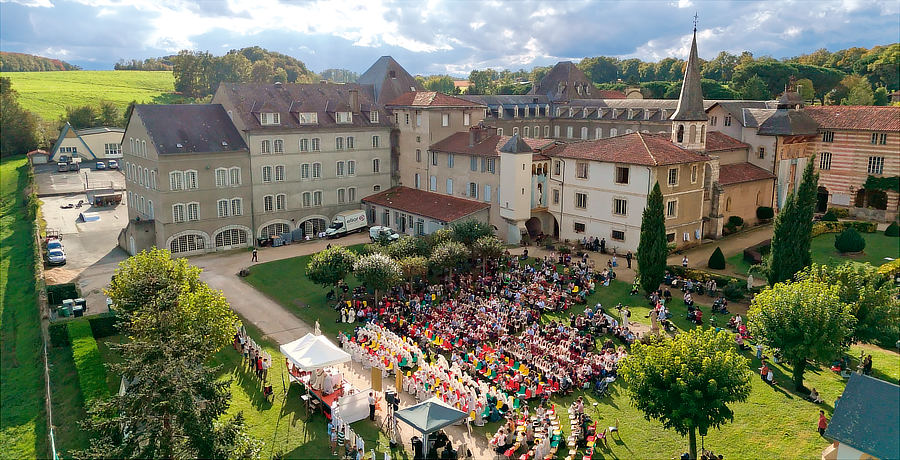
The sanctuary and educational institution of Our Lady of Garaison
The Benediction of the Blessed Sacrament that concluded our pilgrimage,
after the reading of Brother Bruno’s letter to the Pope summarising all its intentions.
ADDRESS TO THE HOLY FATHER.
At 3:30 p.m., we gathered once again at the foot of the Eucharistic podium for a final holy hour of reparation, which would bring our pilgrimage to a close. Brother Bruno took the opportunity to read us the letter he had written to the Holy Father on October 13. Reading the latest apostolic exhortation, Dilexi Te, devoted to love for the poor, we were disappointed to find in it all the Progressivism of his predecessors, the double movement of naturalising the supernatural and supernaturalising the natural, denounced by Father de Nantes since 1958 in his first letters on The Mystery of the Church and the Antichrist.
Brother Bruno nevertheless decided to take advantage of the Pope’s concern for the needy in order to draw his attention to a category of poor people whom he clearly does not think about, even though they are the most miserable of all, and in any case the ones for whom Our Lady of Fatima revealed Her anguished concern: poor sinners who fall into Hell, “because there is no one to sacrifice themselves and pray for them” (August 19, 1917).
“To save them, God wants to establish in the world devotion to My Immaculate Heart” (July 13, 1917).
This is why our Brother renews to His Holiness Pope Leo XIV the urgent pleas, which Sister Lucy, the messenger of Heaven’s will, had addressed in her days, to his predecessors: that the Holy Rosary be promoted to the dignity of liturgical prayer, that the feast of the Immaculate Heart of Mary be elevated to the rank of a solemn feast to become one of the most important feasts of the Church, and, above all, that the reparatory devotion of the First Saturdays of the month be approved and encouraged.
The celebrant then brought Jesus in the Eucharist to the altar and we were able to commend this letter to our heavenly intercessors throughout a final Rosary and the Benediction of the Blessed Sacrament that followed. A warm sun had victoriously dispersed the clouds, but even more so, the Immaculate Heart of Mary had warmed the hearts of Her children, for it is true that when we are determined to console Her, She is unmatched in Her generosity and takes even greater care of all our intentions.
After a final blessing from Jesus the Eucharist and the singing of Yvon Leca’s "Phalange de l’Immaculée" (Phalange of the Immaculate), it was time to part, having rekindled our Phalangist charity in the ardent hearth of the Immaculate Heart of Mary.
“This Heart is the magnet that draws souls to Me, the centre from which radiate the rays of My light and My love on earth, the inexhaustible spring that pours out the living water of My mercy on earth.” (Our Lord to Sister Lucy, 1943)
CONCLUSION: THE CHURCH OF THE CATACOMBS
Here is the sermon that Brother Bruno gave on Tuesday morning, at the six o’clock Mass, before we got back on the buses. An unexpected power outage provided the perfect backdrop to make the imagery of this final torchlight exhortation even more striking!
My dear brothers, sisters, and friends,
As we part, this nocturnal Mass, celebrated almost in secret, brings to mind the image of a Church in the catacombs, which our Father already evoked in a sermon delivered in Rome on May 14, 1983, at the Catacombs of Saint Callixtus, precisely. We are not like the Christians of the first centuries, who confessed their faith in an aggressively corrupt world, without fearing either fire or the teeth of wild beasts! The persecutions we endure in the Church have nothing in common with those of our brothers who are being slaughtered in Islamic lands or handed over by the Vatican to the Chinese Communists. We are nothing compared to them, but we are of their lineage, bearing witness to the same Faith.
To sum up our struggle, it suffices to recall that in 1858, Our Lady revealed here in Lourdes, “I am the Immaculate Conception,” and that this most holy Name does not appear once in all the Acts of the Second Vatican Council! On June 13, 1917, Our Lady of Fatima told us: “Jesus wants to establish in the world devotion to My Immaculate Heart.” However, on December 7, 1965, Paul VI, the wretch, proclaimed before the conciliar assembly a completely different “devotion”: “We more than anyone else, have the cult of Man.”
Well, in reparation for this impiety, we, more than anyone else, want to have the cult of the Immaculate Heart of Mary! We profess all the truths revealed by Jesus and Mary, sent by our beloved Heavenly Father, and which they have reminded us of in recent times to warn us of the great apostasy. We believe in them with divine faith! That is why our Father inserted the dogma of the Immaculate Conception into the recitation of the Creed!
Thus, like the martyrs, we bear witness to our Faith. Not to our virtues, our merits, but to our Faith. We must know this: the supreme merit of a man is to keep the Faith! It is on Faith that we will be judged. Without faith, no one can please God! And so, for this Faith, we are ready to live and die in the certainty of the promised resurrection. “I believe in the Immaculate Conception!”
On Saturday, the sight of our crowd in the immense underground basilica, raising prayers and hymns to Jesus in the Eucharist, gave us an image of the serene strength and joyful hope of a Church in the catacombs, sure of her Faith, inseparable in her charity.
“One cannot pray under this vault,” our Father wrote in 1958, “without thinking of the atomic bomb, of world communism, of the immense mass graves of persecution.”● And we add in 2025: without thinking of the rigid and cold body of our poor mother, the Church!
“But,” our Father continued, “this tomb is full of light, as at the dawn of a sure resurrection. This is the image we take away from Lourdes.”
My dear friends, my dear children, the night is coming to an end, dawn is breaking, the great day of the victory of the Immaculate Heart of Mary is dawning. “And it will be our happiness to have worked and suffered a little for this triumph.” (Sister Lucy) So be it!
Brother Guy of Mercy
Letter to Our Friends no. 43, August 15, 1982
This is a play on words, or more precisely, a play on initials. In French, ADN are the initials for Abbé de Nantes (Father de Nantes) and also for acide désoxyribonucléique (deoxyribonucleic acid – DNA). CRC are the initials for Contre-Réforme Catholique (Catholic Counter-Reformation).
Georges de Nantes, Mystical Page No. 84, Christmas 1975
Cachot: a prison cell – this was the name given to the single room where the entire Soubirous family resided, which was in a disused jail.
The Hill of Espélugues is a rock formation which, a short distance away, towers over the Massabielle rock in which Our Lady’s grotto is found. The Capucin Father Marie-Antoine, who devoted himself to developing the pilgrimages to Lourdes, had a monumental Way of the Cross installed on the slopes of this rock.
Le Lis immaculé, manuel du pèlerin de Lourdes (the first handbook written for pilgrims)
Histoire exacte de la vie intérieure et religieuse de sainte Bernadette (Exact History of the Interior and Religious Life of Saint Bernadette), Father Petitot
Mystical Page no. 90, August 1976
Mystical Page no. 90, August 1976 also published in He is Risen No. 68.
Petit traité sur le chapelet (Short Treatise on the Chaplet), August 1999
Lourdes, no. 157
Letter to My Friends No. 38
Letter to My Friends No 38
The Book of Judges
Chapters 4 and 5.
Letter to My Friends no. 38, July 1958